AI Detects Car Damage, Predicts Repair Costs with High Accuracy
A new AI framework leverages deep learning to accurately identify vehicle damage and uses machine learning to estimate repair costs, showing significant promise for insurance and automotive industries.
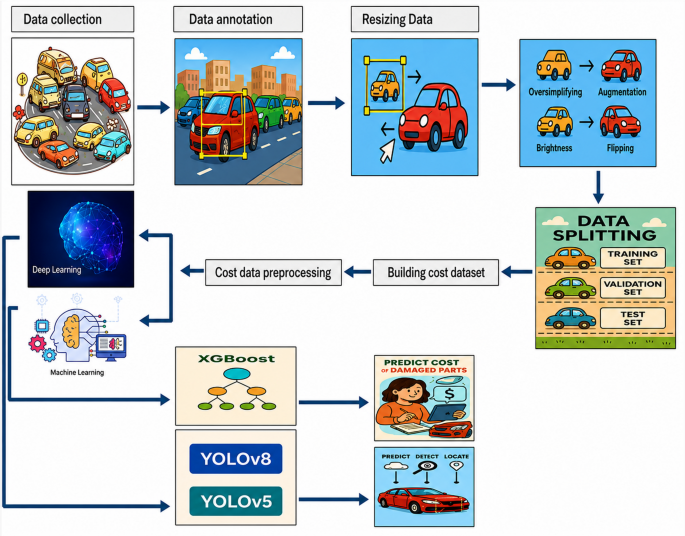
A new AI framework combines deep learning and machine learning to accurately detect vehicle damage and predict repair costs, streamlining assessments and reducing human error.
The Need for Automated Vehicle Damage Assessment
The automotive industry is experiencing a rapid evolution, with an increasing demand for advanced systems, particularly in areas like autonomous driving and automated inspection. A significant challenge within this sector has always been the effective classification, detection, and localization of vehicle damage for assessment purposes. Traditionally, this process has relied heavily on manual inspection by human experts—a method that is known for being time-consuming, resource-intensive, and prone to inconsistencies. The subjective nature of human assessment, combined with the sheer volume of potential defects, often leads to varying results and increased operational costs for entities such as insurance companies and repair facilities.
Advancements in AI for Damage Detection
For some time, artificial intelligence (AI), particularly convolutional neural networks (CNNs), has shown promise in analyzing images to identify vehicle damage. CNNs are adept at learning intricate patterns from visual data, making them suitable for classifying different types of damage like scratches and cracks, especially when large datasets are available for training. However, a significant limitation of early CNN applications was their inability to pinpoint the exact location of damage; they could only classify its presence. This deficiency spurred the development of more sophisticated object detection frameworks, such as You Only Look Once (YOLO), which can not only identify the type of damage but also provide bounding box coordinates marking its precise location within an image.
Recent innovations have further enhanced these capabilities. Researchers now explore using multi-angle or even three-dimensional images to provide more comprehensive views, significantly boosting detection precision by capturing damage from various perspectives. Furthermore, modern systems are also improving their ability to assess the severity of damage and differentiate between various damage types, offering a more nuanced understanding of vehicular distress. Techniques like R-CNN, which are advanced forms of segmentation, have been employed to precisely delineate damaged areas, proving particularly useful for irregularly shaped damage.
An Integrated Approach to Damage Detection and Cost Prediction
Despite these significant strides in damage detection and classification, a notable gap has persisted in the field: the reliable prediction of repair costs directly linked to identified damage. Previous research had suggested the necessity of developing datasets that could support not only damage identification but also the estimation of associated repair expenses. Addressing this critical need, a new study introduces a novel, end-to-end framework. This system integrates advanced object detection, classification, and cost prediction capabilities, offering a comprehensive solution for automated vehicle damage assessment.
The framework leverages YOLO models (specifically YOLOv5 and YOLOv8) for the initial stages of damage detection and classification. These models are trained to identify various damage types, including broken lamps, shattered glass, cracks, scratches, and dents. Following successful damage identification, an XGBoost machine learning model is utilized to predict the repair costs. This combined approach signifies a substantial leap forward, moving beyond mere damage recognition to provide actionable financial insights.
The New Dataset and Enhanced Performance
A key innovation underpinning this framework is the creation of a custom, expert-annotated dataset compiled from scratch. This dataset is meticulously designed to bridge the gap between visual damage attributes and quantitative cost estimation. It includes precise bounding box annotations for damaged areas, categorized damage types, severity levels, spatial locations, and corresponding repair cost data. This comprehensive dataset was crucial for training both the deep learning and machine learning components effectively, a resource previously unavailable in integrated form.
Performance metrics for the proposed framework are impressive. The YOLOv8 model demonstrated superior capabilities compared to YOLOv5, achieving an 87% precision rate on the validation dataset and a mean absolute precision of 90.7% on the test dataset for detecting and classifying vehicle damage. For repair cost prediction, the XGBoost model attained an R² score of 97.28% and a Mean Absolute Error (MAE) of 128.50. These results, reported in an article by researchers in Nature, confirm the framework's ability to significantly enhance the precision of vehicle damage assessment, while also accelerating the process and ensuring its effectiveness in practical, real-world deployment scenarios.
Why it matters
This development has significant implications for industries reliant on efficient and accurate vehicle damage assessment, particularly in telecommunications and data center operations where fleet management and equipment maintenance are critical. Automating the damage assessment process for service vehicles or specialized equipment can drastically reduce inspection times, minimize human error, and provide rapid, consistent repair cost estimates. This allows telco and data center operators to streamline logistics, optimize maintenance schedules, and improve budget forecasting. Integrating such AI tools can lead to faster decision-making for repairs or replacements, ultimately enhancing operational efficiency and reducing downtime for vital infrastructure assets.
More from Trends
RSS
Access Denied: Unable to Generate Article Without Source Content
The provided source content leads to a paywall, preventing access to the original article text. Therefore, an original journalistic piece cannot be generated.

AI's Expanding Frontier: From Cosmic Models to Corporate Strategies
This briefing explores the latest in AI, from groundbreaking universal models to its transformative impact on global employment, finance, and geopolitics, reshaping industries.

The Rise of Ollobot: Redefining Human Connection Through AI Companionship
Ollobot, a pioneering AI companion robot, is transforming how individuals experience social interaction and support in their homes, addressing a growing need for connection.