Beyond FAIR: The COPE Framework for AI-Ready Scientific Data
Scientific data's growing complexity demands more than just findability and accessibility. The new COPE framework extends FAIR principles to make data truly AI-ready.
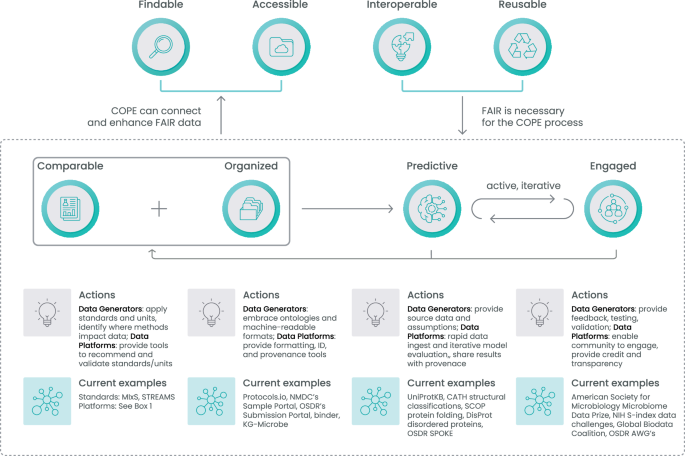
The FAIR data principles, while foundational, are insufficient for the current demands of AI-driven scientific research; an extended framework, COPE (Comparable, Organized, Predictive, Engaged), is essential for making data truly AI-ready and iteratively improvable.
The Evolving Landscape of Scientific Data
Scientific research, particularly in fields like biology and environmental studies, is increasingly reliant on complex and diverse datasets. What was once considered a monumental achievement, such as sequencing a single microbial genome, is now routinely performed, even by undergraduate students. This shift underscores the explosion in data generation. However, understanding intricate biological and environmental systems today demands the integration of many different data types, varying in frequency, origin (from human observations to sensor readings), and scale.
Traditionally, a major hurdle has been simply finding and accessing relevant data. The implementation of FAIR data principles – Findable, Accessible, Interoperable, and Reusable – has significantly alleviated this. FAIR principles have fostered the adoption of community-specific, machine-actionable standards and the development of new curation tools. While these advancements are crucial for data discoverability and basic reusability, they do not fully address the challenges of integrating disparate datasets for advanced analytics, particularly those driven by Artificial Intelligence.
The Limitations of FAIR Data for AI Integration
Despite the widespread adoption of FAIR principles, significant obstacles remain when attempting to integrate multiple, diverse datasets for meta-analysis or AI applications. A core issue is the manual, time-intensive process required to understand how different datasets are structured and organized. This manual effort makes large-scale data integration cumbersome. Furthermore, scientific knowledge is constantly evolving. Existing FAIR databases often lag in reflecting these changes, leading to stale annotations and incorrect relationships propagating through the data. This problem is exacerbated when AI systems, which rely heavily on vast amounts of data, ingest and amplify these outdated or erroneous connections.
The challenge goes beyond static datasets. Considerations such as data quality assessment, tracking data provenance, managing recalculations and different versions of data products, and presenting various analytical outputs for microbiome studies, for example, illustrate the technical complexities in effective data reuse and synergy. The current approach often fails to provide a robust, dynamic system for data management that can keep pace with continuous scientific discovery and the rapid advancements in AI.
Introducing FAIR+COPE: An Iterative Approach
To overcome these limitations, a new, extended framework called FAIR+COPE is proposed. COPE stands for Comparable, Organized, Predictive, and Engaged. This framework builds upon FAIR by advocating for data that is iteratively updated and improved. It suggests that data should be:
- Comparable: Datasets from different sources must be transformable into equivalent units and adhere to standardized methodological parameters, making apples-to-apples comparisons possible.
- Organized: Data needs to be structured with consistent ontological labels and standardized terminology, enabling clear understanding of inferred relationships and facilitating consistent interpretation across studies.
- Predictive: The goal is to make data ready for advanced predictive models. This includes explicit labeling and versioning of underlying models that define comparability and organization, ensuring that the origins and transformations of data are transparent.
- Engaged: An active, engaged community is crucial for validating and refining predictive models and underlying data. This iterative feedback loop ensures that as new knowledge emerges, the data, its organization, and the models built upon it are continuously updated and improved.
The COPE process is not a static set of rules but rather an iterative cycle. As new knowledge is generated through testing and validation, updates are made to the Comparable and Organized data, and predictive models are regenerated and re-evaluated. This active, iterative scientific process is fundamental to creating and maintaining the accurate predictive inferences that underpin AI tools and long-term data reuse.
From Manual Bottlenecks to Automated, Reproducible Data Flows
Currently, many aspects of the COPE process, particularly data harmonization and integration, are manual, narrow in scope, and often lack transparency and reproducibility. Even when data is FAIR, integrating domain-specific data across studies often devolves into manual conversions, consistent labeling efforts, and localized predictive analyses performed on sometimes outdated software versions.
To accelerate FAIR+COPE, the application and assessment of units, parameters, standards, tools, and database updates must be automated and thoroughly documented. This automation should also extend to making these processes available for community validation. According to an article in Nature, predictive assertions should encompass not only analysis outputs from comparable, organized data but also necessary updates to the labels or models that facilitate comparability and organization. The framework emphasizes that while COPE does not dictate which predictive models to use, it does require explicit labeling, version control, and clear links to the original FAIR data from which predictions are derived. This ensures that data from diverse origins can be confidently integrated, updated, and prepared for modeling and AI-driven workflows.
Early examples of automation, such as leveraging large language models (LLMs) with FAIR-aligned workflows, demonstrate the feasibility of this vision. These technologies can help streamline the complex tasks of data annotation, standardization, and integration, moving scientific data management towards a more robust, dynamic, and AI-ready future.
Why it matters
For AI applications, especially in fields like telecommunications, data center operations, and infrastructure management, the FAIR+COPE framework is critical. AI models in these sectors rely on integrating vast amounts of diverse, real-time data from sensors, network logs, and operational systems. Without truly Comparable and Organized data, AI systems face significant challenges in accurately predicting anomalies, optimizing resource allocation, or performing predictive maintenance. The Engaged community aspect is particularly relevant for technicians and engineers, whose operational insights are vital for validating and refining AI models, ensuring that predictions align with real-world complexities and evolving infrastructure. Implementing COPE ensures that the data pipelines feeding AI are not just accessible but are continually adapt in quality and relevance, enhancing the reliability and effectiveness of AI-driven decisions within critical infrastructure.
More from Trends
RSS
Access Denied: Unable to Generate Article Without Source Content
The provided source content leads to a paywall, preventing access to the original article text. Therefore, an original journalistic piece cannot be generated.

AI's Expanding Frontier: From Cosmic Models to Corporate Strategies
This briefing explores the latest in AI, from groundbreaking universal models to its transformative impact on global employment, finance, and geopolitics, reshaping industries.

The Rise of Ollobot: Redefining Human Connection Through AI Companionship
Ollobot, a pioneering AI companion robot, is transforming how individuals experience social interaction and support in their homes, addressing a growing need for connection.