Optimizing Federated Learning in IoT for Enhanced Edge AI
New research introduces a novel framework that significantly improves how IoT devices are clustered and assigned within federated learning systems at the network edge.
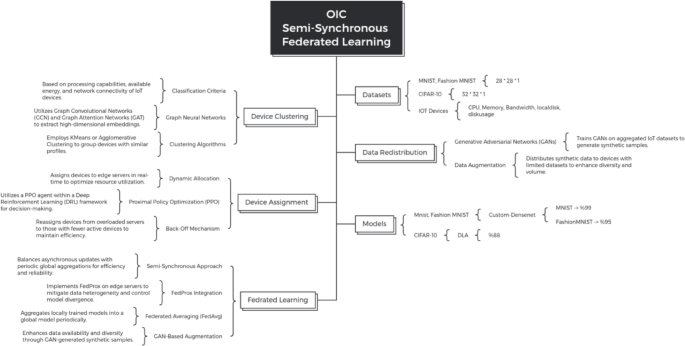
A new approach significantly boosts the efficiency and accuracy of federated learning in Internet of Things ecosystems by intelligently clustering devices and optimizing resource allocation.
The Promise and Peril of Federated Learning at the Edge
Federated Learning (FL) represents a pivotal shift in how machine learning models are trained, offering a decentralized paradigm where multiple devices collaboratively learn without ever centralizing their raw data. This approach is particularly critical for the vast and rapidly expanding Internet of Things (IoT), where data privacy is paramount and devices often operate with limited resources. By keeping data local, FL mitigates the security and privacy risks associated with traditional centralized data collection, making it highly suitable for diverse IoT environments. Its core strength lies in its ability to enhance model accuracy and scalability by effectively managing the inherent heterogeneity of IoT devices and optimizing resource allocation.
Despite FL's clear advantages, widespread adoption in resource-constrained IoT systems faces several significant hurdles. One major challenge arises from the non-identical and often independent data distributions across devices. This 'non-IID' data can lead to reduced model performance and difficulties in achieving stable learning convergence. Furthermore, energy consumption and communication delays remain critical concerns, especially in large-scale, hierarchical FL architectures. Existing research has proposed various solutions, including advanced scheduling algorithms and resource optimization frameworks. However, these often struggle to strike an optimal balance between efficiency and accuracy, leaving a clear gap in current methodologies.
The increasing complexity of IoT deployments necessitates more robust and efficient FL techniques. Traditional methods often fall short in combining high model accuracy with effective device clustering algorithms, resulting in suboptimal performance and inefficient resource utilization. This highlights an urgent need for innovative strategies that not only improve model training accuracy but also refine how devices are grouped and managed within these decentralized learning systems.
A Hybrid Approach to Device Management
Recent advancements in this field introduce a sophisticated framework designed to address these limitations. This new methodology specifically targets the optimization of device clustering and assignment to edge servers, alongside innovative data redistribution strategies, all within a hierarchical semi-synchronous federated learning structure. The overarching goal is to significantly boost the performance and scalability of FL systems by enhancing resource allocation and data processing efficiency, thereby strengthening the foundation of edge computing infrastructures.
The framework begins by leveraging Graph Neural Networks (GNNs) to intelligently group IoT devices. This clustering is performed based on each device's unique hardware specifications and the characteristics of its local datasets. Following the initial GNN-driven categorization, the well-established K-means algorithm is applied to further refine these groups into efficient device clusters. This two-stage clustering ensures that devices with similar operational profiles and data types are intelligently organized, creating more homogeneous learning groups.
Once devices are clustered, a crucial step involves data redistribution. The Hybrid Data Redistribution technique is employed to equalize the local datasets within each cluster. This step is vital for mitigating the 'non-IID' data problem, ensuring that each device within a cluster contributes more evenly and effectively to the overall model training. By balancing the data distribution, the system can achieve better model convergence and higher accuracy.
Dynamic Resource Allocation and Performance Gains
The final component of this innovative framework involves optimizing the allocation of device clusters to specific edge servers. This is achieved through the Proximal Policy resource allocation optimization algorithm. This algorithm dynamically assigns devices to edge servers by continuously monitoring and responding to real-time updates in bandwidth usage and energy consumption. This adaptive resource management ensures that computational loads are distributed efficiently, minimizing latency and maximizing throughput across the network. This dynamic allocation is crucial for supporting hierarchical semi-synchronous federated learning, which in turn leads to significant improvements in overall model training effectiveness.
The results of this new approach are compelling, demonstrating a palpable improvement in key performance indicators. The research shows a 15% increase in clustering metrics when compared to existing algorithms. This improvement underscores the effectiveness of the hybrid approach in enhancing device assignment and data redistribution within hierarchical semi-synchronous federated learning environments. The methodology successfully tackles long-standing issues concerning model accuracy and resource optimization, paving the way for more robust and scalable FL deployments in complex IoT ecosystems.
This research, published in Nature, marks a significant step forward in optimizing federated learning processes for edge computing. By integrating advanced clustering, data redistribution, and dynamic resource allocation, it provides a comprehensive solution to some of the most pressing challenges in decentralized AI, offering substantial benefits for the future of intelligent IoT systems.
Why it matters
For AI, technicians, telco, and data centre operations, this research is highly significant. In AI, optimizing federated learning directly translates to more accurate and efficient AI models running on edge devices, reducing the need for massive data transfers to centralized data centers and improving real-time decision-making capabilities. For technicians, particularly those in telecommunications and IoT, this framework offers a blueprint for designing and maintaining more resilient and performant networks. Efficient device clustering and resource allocation mean less network congestion, better utilization of edge server capacity, and reduced energy consumption. Data centre operations benefit from offloading considerable processing from the core network to the edge, lessening the computational burden and associated resource demands. The ability to manage heterogeneous IoT devices more effectively ensures that future distributed AI applications can scale without compromising performance or privacy, which is critical for supporting the next generation of smart infrastructure and services.
More from Trends
RSS
Access Denied: Unable to Generate Article Without Source Content
The provided source content leads to a paywall, preventing access to the original article text. Therefore, an original journalistic piece cannot be generated.

AI's Expanding Frontier: From Cosmic Models to Corporate Strategies
This briefing explores the latest in AI, from groundbreaking universal models to its transformative impact on global employment, finance, and geopolitics, reshaping industries.

The Rise of Ollobot: Redefining Human Connection Through AI Companionship
Ollobot, a pioneering AI companion robot, is transforming how individuals experience social interaction and support in their homes, addressing a growing need for connection.