Bridging the AI Divide: Repurposing Adult Models for Neonatal Care with Continual Learning
A global study demonstrates a privacy-preserving approach, continual learning, can effectively adapt AI models trained on adult data for critical neonatal applications, overcoming data scarcity and privacy challenges.
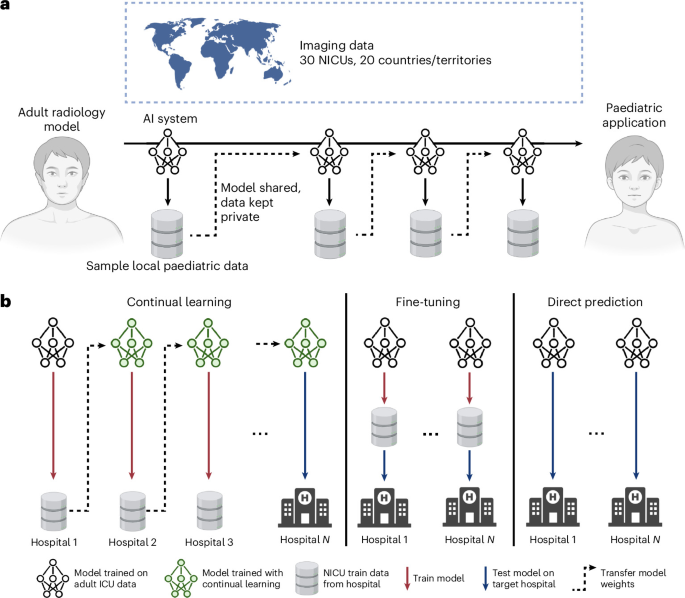
AI models traditionally trained on adult medical data can be safely and effectively repurposed for neonatal care through a novel privacy-preserving continual learning approach, addressing a critical gap in pediatric AI deployment.
The Pediatric AI Gap
The landscape of artificial intelligence in medical imaging currently exhibits a significant imbalance. The vast majority of AI models developed for radiology are designed and trained using adult patient data. This bias is starkly reflected in regulatory approvals, with less than one-fifth of commercially available AI models receiving clearance for use in pediatric patients. This disparity is not merely an oversight; it stems from fundamental differences between adult and pediatric physiology, imaging protocols, and the relative scarcity of comprehensive pediatric datasets. When adult-trained AI models are applied to neonatal or pediatric imaging, their performance often degrades significantly. This poor generalization highlights a critical unmet need for specialized AI tools in pediatric medicine.
Developing AI for children, particularly neonates, presents unique challenges. Curating and meticulously labeling clinical data from pediatric populations is an arduous task, demanding substantial effort and specialized expertise. Furthermore, strict privacy regulations, especially concerning sensitive data from minors, heavily restrict the sharing of patient information across institutions. This regulatory environment makes the aggregation of large, diverse datasets, which are crucial for robust AI training, exceedingly difficult. Consequently, children are severely underrepresented in public medical imaging datasets, comprising less than 1% of available data. These formidable barriers often lead to pediatric AI models being developed and validated using data from a single institution, limiting their generalizability and raising concerns about their performance in varied clinical settings. The absence of effective, data-efficient strategies for adapting existing adult AI models to pediatric contexts, without necessitating extensive data sharing or local data curation on a massive scale, has been a persistent hurdle.
A Collaborative Learning Breakthrough
To overcome these challenges, an international research initiative embarked on a retrospective study spanning 30 neonatal intensive care units (NICUs) across 20 countries and territories. The objective was to validate a collaborative, multi-hospital method for adapting an AI model initially developed for adults to serve neonatal patients. Crucially, this approach utilized only small, localized datasets from each participating site, circumventing the need for any institution to share patient data centrally. This privacy-preserving methodology is particularly significant in an era of stringent data governance and privacy concerns.
As a proof-of-concept, the study focused on endotracheal tube (ETT) assessment. ETTs are vital for supporting respiration in critically ill neonates, but their correct placement is challenging due to the small anatomical margins involved. Misplaced ETTs, such as those inserted too deeply, can lead to serious complications like single lung ventilation and lung collapse. Conversely, false alarms prompting unnecessary re-intubations increase procedural risks for fragile infants. While AI tools exist for ETT assessment in adults, no commercial solutions were available for neonates. The study aimed to demonstrate that an adult-trained AI model could be successfully adapted to this critical neonatal task.
Continual Learning in Action
The core of the research involved a technique known as continual learning. Instead of pooling all neonatal data centrally, each hospital contributed a modest set of 50 radiographs. These images were then used to sequentially retrain the adult-trained AI model in an iterative process, allowing the model to adapt to the unique characteristics of neonatal chest radiographs without direct data sharing between institutions. This decentralized approach is key to its privacy-preserving nature. The performance of this continually learned model was then rigorously evaluated.
The results were compelling. The continually learning model demonstrated significantly improved accuracy in localizing anatomical landmarks on neonatal radiographs. It achieved an average localization error of just 0.67 centimeters, a substantial improvement compared to the 1.29 centimeters seen with hospital-specific fine-tuning (where models were retrained individually at each site without the collaborative, sequential approach) and a dramatic reduction from the 4.30 centimeters error exhibited by the original adult-only models. This enhanced precision was observed at 29 out of the 30 participating sites. Furthermore, the model's ability to detect deep intubations – a critical safety concern – also improved significantly at 27 of the 30 sites. These findings underscore the effectiveness of continual learning as a robust and privacy-compliant strategy for adapting AI models to niche medical applications where data scarcity and privacy are paramount concerns.
Impact on Clinical Practice
Endotracheal intubation is a frequent procedure in both adult and neonatal intensive care units. In neonates, the margin for error is extremely small. Clinicians often make initial interpretations of radiographs at the bedside, but incorrect ETT placements can be missed until a specialist radiologist provides a more thorough review. This delay can have serious consequences for the infant. The research highlights that even experienced interpreters can occasionally overlook subtle inaccuracies in ETT positioning, and less experienced staff are more prone to such errors. An AI model capable of accurately flagging concerning radiographs at the bedside could act as an invaluable safety net, triaging the most critical cases for immediate radiologist review and potentially shortening the time to definitive diagnosis and intervention.
Such an AI assistant would not replace human expertise but would augment it, providing a consistent and rapid initial assessment. By identifying misplaced tubes quickly, the AI could help prevent adverse events associated with deep intubations and reduce the need for repeat procedures. The Nature study's success in adapting an adult AI model for this complex neonatal task demonstrates a viable pathway for addressing other critical gaps in pediatric AI, fostering safer and more efficient care for the most vulnerable patients, all while respecting strict data privacy requirements through innovative collaborative learning strategies.
Why it matters
This research is highly relevant to in-field AI, technicians, and data center operations. For AI developers and technicians, it presents a practical, scalable method for deploying AI in data-sensitive environments like healthcare, illustrating how continual learning can overcome the hurdles of limited specialized data and strict privacy regulations. For data center operations, the decentralized nature of this collaborative learning approach implies a reduced need for massive centralized data storage and processing, potentially distributing computational load and enhancing data security. This model minimizes the risk associated with pooling sensitive patient data, which is a major concern for both telco infrastructure handling medical data and data centers managing large healthcare datasets. It offers a blueprint for developing AI solutions in other specialized or rare conditions, ensuring that AI's benefits extend beyond commonly studied adult populations without compromising patient privacy or data integrity. The ability to adapt existing, well-validated adult models means faster deployment and reduced development costs for new pediatric AI tools, directly impacting the operational efficiency and ethical considerations within medical AI deployment.
More from Trends
RSSEdge AI System Revolutionizes Packaging Line Efficiency and Anomaly Detection
A novel lightweight AI system, deployed directly on manufacturing equipment, significantly enhances anomaly detection and slashes energy consumption in high-speed liquid packaging lines.

CERN and Mistral AI Collaborate to Forge Groundbreaking AI for Physics
CERN and Mistral AI have announced a partnership to develop "Flare," a revolutionary AI foundation model designed to accelerate discovery in high-energy physics.

Hesai Unveils Kosmo Spatial Camera, Aiming to Revolutionize AI Robotics with Enhanced Data Collection
Hesai Group, a leading lidar supplier, has introduced Kosmo, a new spatial camera designed to provide high-quality 3D data for training AI-powered robots, addressing a critical gap in the robotics industry.
