Clinical AI Models Face Reproducibility Crisis as Code Sharing Falls Short
A new review highlights that while clinical AI models are increasingly critical, their underlying code is rarely shared effectively, posing significant reproducibility challenges.
Clinical prediction models, vital for modern healthcare decisions, are often built on foundations of code that are inadequately shared, impeding their transparency, reproducibility, and generalizability for real-world application.
The Growing Role of Clinical Prediction Models
Clinical prediction models are becoming indispensable tools in healthcare, offering critical support for diagnostic and prognostic decisions across a wide array of medical settings. These models, often powered by artificial intelligence and machine learning, promise to enhance patient care by predicting disease outcomes, identifying individuals at risk, or guiding treatment strategies. However, for these sophisticated tools to be genuinely trustworthy and deployable in clinical practice, they must first satisfy rigorous standards of validity and reliability. A fundamental aspect of this validation process is the ability to independently assess and reproduce their performance. This requires a level of transparency that often hinges on access to the analytical code used in their development.
The analytical code underpins every stage of a model's creation, from the initial preprocessing of raw data to the selection of algorithms, tuning of parameters, and the final evaluation of performance. Without access to this code, independent researchers and clinicians cannot fully scrutinize the methodology, verify the reported results, or confidently apply the models to new patient populations. Despite this critical need, the availability of such code in published research remains surprisingly limited, creating a significant hurdle for the broader scientific community.
A Call for Greater Transparency and Reproducibility
Concerns surrounding computational transparency in scientific research are not new. Over recent years, various initiatives have emerged to champion better sharing and reporting practices. The FAIR principles, for instance, establish a framework for making digital research assets Findable, Accessible, Interoperable, and Reusable. Similarly, the EQUATOR Network has developed comprehensive reporting guidelines to elevate methodological clarity across different study designs. Many academic journals and funding bodies now mandate statements on data and code availability, aiming to foster a culture of reproducibility.
In the realm of clinical prediction research specifically, the TRIPOD Statement, and its more recent update, TRIPOD+AI, were developed to improve the completeness and clarity of model reporting. These guidelines have been instrumental in promoting higher methodological quality, encouraging external validation, and ensuring proper calibration of prediction models. Yet, while TRIPOD+AI advocates for sharing analytical code, it does not explicitly define specific standards for how repositories should be structured, what level of documentation is required, or how to ensure the code is truly reproducible. This ambiguity has led to inconsistent practices, making it difficult to gauge the actual extent and quality of code sharing in this vital field.
AI Reveals a Troubling Trend in Code Sharing
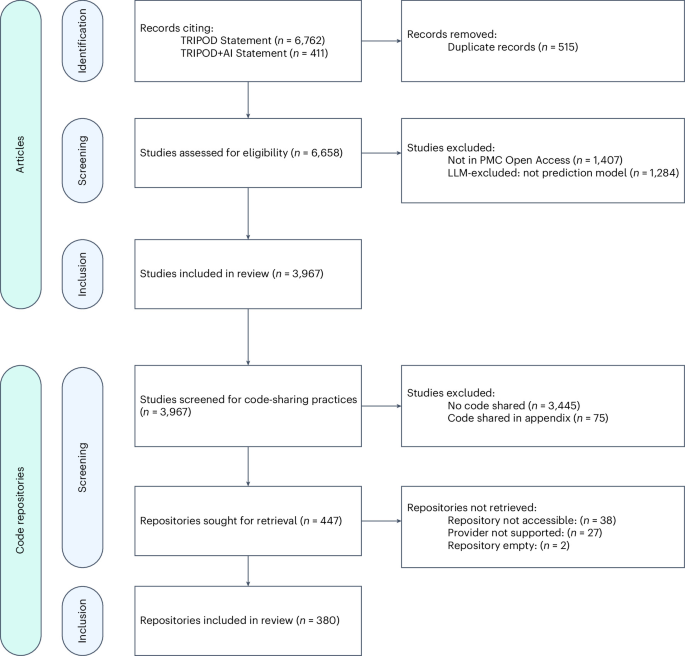
To shed light on the state of code sharing, a recent study harnessed the power of large language models (LLMs) to conduct an extensive scoping review. The researchers developed an LLM-assisted pipeline to screen thousands of articles that cited either TRIPOD or TRIPOD+AI. This automated approach allowed them to efficiently identify articles, extract links to code repositories, and then assess these repositories against 14 predefined features crucial for reproducibility. The scale of this investigation—screening nearly 4,000 articles—would have been prohibitively labor-intensive using traditional manual review methods.
The findings were stark: out of 3,967 articles analyzed, only 482 (12.2%) contained explicit statements about code sharing. This low prevalence varied significantly depending on the journal and the country where the research originated. Furthermore, simply declaring code availability did not guarantee its utility. The assessment of the identified repositories revealed considerable heterogeneity in reproducibility-related features. Many repositories lacked essential elements such as comprehensive documentation, clear specifications for software dependencies, or an executable structure that would allow other researchers to easily run and verify the models.
This outcome aligns with broader evidence from biomedical literature, which consistently shows that while code sharing is generally infrequent, even when code is supposedly available, it is often not functionally accessible or reproducible. Previous studies have attempted to re-run Jupyter notebooks linked to biomedical articles, with success rates as low as 5.3%. Manual reviews of code in deep learning conferences and computational pathology articles have similarly found that only a fraction of publicly available code is truly repeatable. The Nature paper highlights that the problem is not just about whether code is shared, but how it is shared.
The Path Forward: TRIPOD-Code and Enhanced Standards
These findings underscore a critical need for more stringent expectations beyond mere code availability. For clinical prediction models to fulfill their promise and be safely and effectively integrated into healthcare, their underlying code must be shared in a manner that facilitates genuine reproducibility and reusability. This involves clear, comprehensive documentation, precise specification of all required dependencies (libraries, software versions, operating systems), and an organized, executable structure that allows others to understand, verify, and build upon the work.
The research reported in Nature serves as foundational work for the development of TRIPOD-Code, a new reporting guideline specifically designed to address these gaps. TRIPOD-Code aims to provide clear, actionable standards for code availability and reproducibility in clinical prediction model research. By establishing explicit criteria for how analytical code should be shared, documented, and made executable, these guidelines seek to improve the usability and impact of clinical prediction model studies. Strengthening these practices is not merely an academic exercise; it is essential for ensuring that the AI tools we develop for healthcare are robust, reliable, and ultimately capable of supporting better patient outcomes in real-world clinical environments.
Why it matters
For those working in AI infrastructure, data centers, and telecommunications, the findings highlight critical considerations for deploying AI in sensitive fields like healthcare. The poor state of code reproducibility means that models intended for clinical use may not be as robust or verifiable as perceived. This impacts data scientists tasked with model deployment, validation engineers ensuring operational integrity, and IT professionals building the secure, high-performance infrastructure needed for these applications. The lack of standardized, executable code means more manual effort in validation, potential for errors, and increased costs in maintaining and updating clinical AI systems. It underscores the necessity for robust MLOps practices, version control, and comprehensive documentation to bridge the gap between research and reliable clinical implementation, ultimately influencing system design for verifiable and auditable AI deployments.
More from Trends
RSSEdge AI System Revolutionizes Packaging Line Efficiency and Anomaly Detection
A novel lightweight AI system, deployed directly on manufacturing equipment, significantly enhances anomaly detection and slashes energy consumption in high-speed liquid packaging lines.

CERN and Mistral AI Collaborate to Forge Groundbreaking AI for Physics
CERN and Mistral AI have announced a partnership to develop "Flare," a revolutionary AI foundation model designed to accelerate discovery in high-energy physics.

Hesai Unveils Kosmo Spatial Camera, Aiming to Revolutionize AI Robotics with Enhanced Data Collection
Hesai Group, a leading lidar supplier, has introduced Kosmo, a new spatial camera designed to provide high-quality 3D data for training AI-powered robots, addressing a critical gap in the robotics industry.
