PRISM2: Bridging Pathology Images and Clinical Dialogue for Advanced Cancer Diagnostics
A new multimodal AI model, PRISM2, integrates vast pathology slide data with clinical reports to achieve human-level diagnostic accuracy in cancer detection.
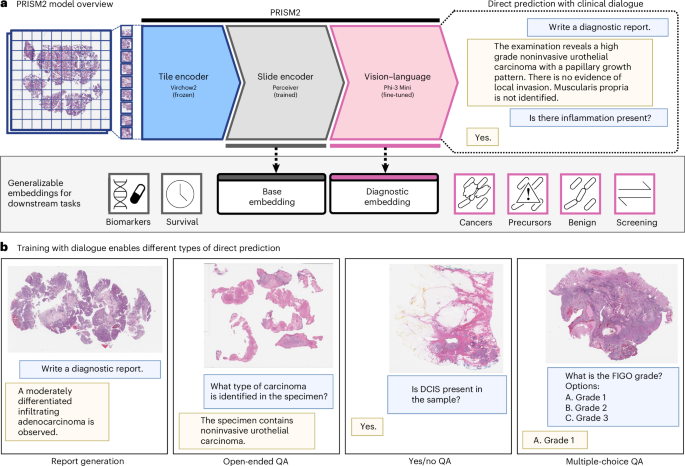
PRISM2, a novel multimodal AI model, leverages an unprecedented dataset of whole-slide pathology images and clinical reports to achieve diagnostic accuracy on par with or exceeding human experts in critical cancer detection tasks.
The Rise of Foundation Models in Pathology
The field of computational pathology has seen significant advancements with the emergence of foundation models. These sophisticated artificial intelligence systems are trained on massive datasets, allowing them to learn generalizable representations of complex medical images. Earlier models, such as Virchow2, UNI2, and H-Optimus-1, primarily focused on analyzing individual histopathology tiles. While these models demonstrated improved performance in tasks like cancer detection, subtyping, and biomarker quantification, their utility for comprehensive, case-level patient diagnostics remained limited. A patient's case typically involves multiple gigapixel whole-slide images (WSIs), requiring the aggregation of thousands of individual tiles for a complete assessment. Current methods often rely on training task-specific tile aggregators with weakly supervised learning, a process that demands extensive data curation and is susceptible to overfitting and a lack of robustness.
Introducing PRISM2: A Slide-Level Breakthrough
PRISM2 represents a significant leap forward by moving beyond tile-level analysis to deliver clinical-grade predictive performance at the slide level. The core challenge in developing such a model is identifying a supervisory signal that effectively compresses long sequences of tile representations while maintaining generalizability across diverse downstream tasks. Previous approaches have explored various signals, including image-only data, paired molecular information, and clinical reports. Recognizing the critical role of data scale in model performance, PRISM2 leverages an unparalleled dataset for its training: 2.3 million whole-slide images paired with 685,000 distinct clinical reports, collectively yielding 14 million question-answer pairs. This extensive dataset encompasses diverse tissue types and originates from multiple institutions, making PRISM2 the largest multimodal slide-level pathology foundation model developed to date.
Multimodal Architecture for Enhanced Diagnostic Reasoning
Unlike earlier models like PRISM and TITAN, which also incorporated text from clinical reports, PRISM2 features a novel dual-embedding architecture. This architecture includes a 'base' embedding designed for transferability to complex and novel tasks, such as biomarker prediction. Complementing this is a 'diagnostic' embedding, derived from the hidden states of a 4-billion-parameter language model. This diagnostic embedding is specifically tuned for clinical tasks, including precise cancer detection and subtyping. While PRISM2 is designed to emulate clinical dialogue, its primary goal is not to function as a conversational agent. Instead, single-turn dialogue serves as a rich supervisory signal, enabling the model to learn semantically grounded and highly generalizable slide-level representations that bridge human diagnostic reasoning with AI performance.
Performance and Clinical Impact
PRISM2's performance metrics are highly impressive. In prompt-based inference, the model achieved or surpassed the balanced accuracy of existing clinical-grade products for cancer detection in critical areas such as the prostate, breast, and breast lymph nodes. This was demonstrated with a statistical significance of P < 0.05. Furthermore, across a comprehensive suite of diagnostic, biomarker, and survival benchmarks, PRISM2's embeddings consistently performed as well as or better than previous foundation models when evaluated via linear probing (P < 0.05). In fact, task-specific fine-tuning for survival prediction with PRISM2 outperformed training a model from scratch on the same large survival dataset. These results underscore PRISM2's capability to deliver clinical-grade performance without requiring additional training, marking a substantial advance toward generalist AI in pathology. The team at Nature, the original publisher, highlights PRISM2's ability to provide a scalable, clinically grounded signal for generalizable pathology representations.
Why it matters
This development is profoundly significant for the future of AI in medical diagnostics, particularly for technicians and data center operations. For technicians in pathology labs, PRISM2 could transform workflows by offering highly accurate, AI-driven preliminary analyses of whole-slide images, reducing the diagnostic burden and potentially accelerating turnaround times. This would allow human pathologists to focus on the most complex cases and validation, thereby optimizing precious human expertise. For data centers, supporting models like PRISM2 necessitates robust, high-performance computing infrastructure capable of handling gigapixel images and immense textual datasets. The training and inference for such a multimodal foundation model require substantial computational resources, including powerful GPUs and efficient data storage and retrieval systems. The demand for scalable, low-latency infrastructure to process vast medical datasets will only grow, making advancements in data center efficiency and AI-optimized hardware crucial for the widespread adoption of such groundbreaking medical AI applications. This innovation paves the way for AI systems that truly understand and interpret complex medical data, bridging the gap between raw visual information and clinical reasoning.
More from Trends
RSS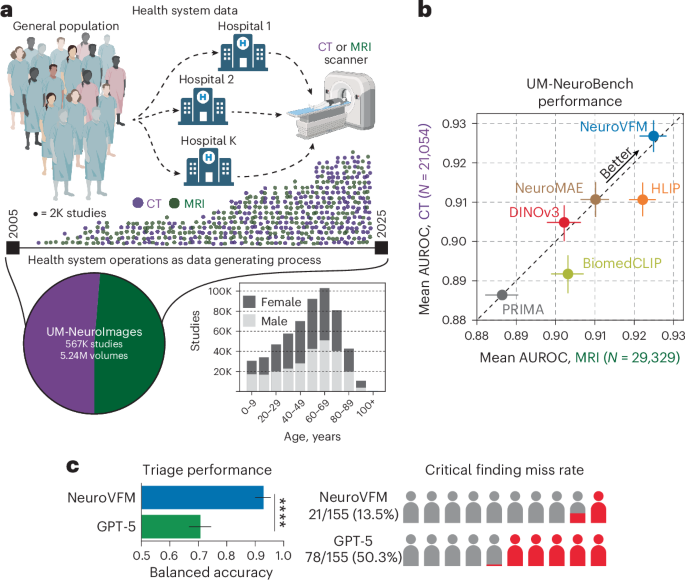
AI Model NeuroVFM Revolutionizes Neuroimaging Diagnostics
A new AI model, NeuroVFM, trained on millions of clinical scans, demonstrates superior diagnostic accuracy and efficiency in neuroimaging compared to existing models.
Humanoid Robots Achieve Surgical Success in Animal Trials
New research demonstrates that humanoid robots can successfully perform complex surgical procedures in animal models, pushing the boundaries of robotic application in healthcare.

Robotics Advances: From Lab Demonstrations to Real-World Applications
Recent developments in robotics showcase advanced capabilities in humanoid and quadrupedal robots, moving beyond controlled environments to practical tasks.