AI's Transformative Role in Uncovering Disease Biomarkers
Artificial intelligence is revolutionizing the discovery of disease biomarkers, moving beyond traditional single-modality analyses to integrate complex, multimodal biomedical data.
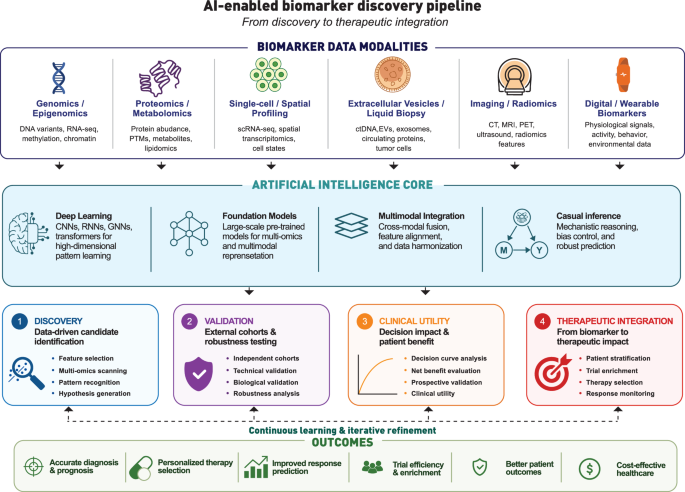
Artificial intelligence is fundamentally reshaping how we discover disease biomarkers, transitioning from simple pattern recognition to sophisticated, mechanistically informed approaches that hold the key to next-generation precision diagnostics and targeted therapies.
The Promise and Pitfalls of Biomarker Discovery
Biomarkers are essential components of modern medicine, guiding how diseases are detected, categorized, and treated. Despite their critical role, the journey from identifying a potential biomarker to its practical application in clinical settings is often fraught with challenges. Many biomarkers that show initial promise in research studies frequently fail to be replicated in independent patient groups, struggle to perform consistently in diverse real-world populations, or simply do not provide enough additional insight to alter medical decisions. This persistent gap between discovery and clinical integration is largely attributable to weaknesses in validation processes, rather than a lack of technological capability or innovative ideas.
Reproducibility is a significant hurdle in biomarker development. The signals measured can be influenced by specific patient cohorts, variations in sample preparation, shifts in testing platforms, batch effects during analysis, and confounding factors arising from co-occurring diseases or ongoing treatments. When dealing with high-dimensional data, the risk of developing models that are overfitted to the initial dataset increases significantly, especially when sample sizes are small and analytical flexibility is high. Furthermore, even when a biomarker appears to perform well, its evaluation often relies on statistical metrics, such as the area under the curve (AUC), which may not directly translate into tangible improvements in patient care or outcomes. This highlights a crucial distinction between statistical performance and actual clinical benefit. Incremental statistical gains often have little impact on clinical decisions, particularly when existing diagnostic methods are already robust or when logistical constraints limit the adoption of new approaches. These limitations underscore that successful biomarker translation demands not just discovery, but rigorous validation, transparent reporting, and a clear demonstration of clinical utility.
A New Era of Data Integration with AI
Biomarker discovery is now operating within an exponentially expanding landscape of measurement technologies. Contemporary research integrates a vast array of data types, including genomic and epigenomic variations, bulk and single-cell transcriptomics, proteomics, metabolomics, circulating nucleic acids, extracellular vesicle content, quantitative imaging features, and longitudinal digital phenotypes derived from wearable sensors and electronic health records. This multidisciplinary approach reflects a deepening understanding of disease biology, recognizing that most conditions stem not from isolated molecular issues but from disruptions across signaling pathways, cellular states, tissue environments, and systemic host responses.
As a result, modern biomarker research faces numerous statistical and biological complexities. These include situations where the number of data features far exceeds the sample size, intricate confounding relationships, significant variability within real-world populations, inconsistencies in protocols and devices across different regions, and temporal changes that can alter biological relationships over time. While traditional statistical methods remain vital for drawing inferences, they are often insufficient for large-scale representation learning and the integration of multimodal data. Artificial intelligence, particularly deep learning, has proven adept at learning hierarchical representations from complex biomedical inputs, showing immense promise, especially in imaging and diverse clinical datasets. However, the abundance of rich datasets also introduces new opportunities for bias and error. Region-specific patterns, unacknowledged confounding factors, and 'label leakage' (where information from the outcome variable inadvertently influences features) can lead to models that appear accurate during development but fail when tested on independent cohorts or in real-world scenarios. Similarly, models might identify superficial correlations that deliver strong predictive performance in development but lack true biological relevance or robustness. This tension between unprecedented opportunities for discovery and the increasing risk of flawed findings represents a central challenge in contemporary biomarker science. Consequently, successful translation depends not only on predictive power but also on stringent validation, meaningful biological interpretation, and the demonstration of reproducible biological relevance.
AI's Role Across the Biomarker Pipeline
Artificial intelligence is profoundly influencing every stage of biomarker development. In the initial discovery phase, machine learning facilitates scalable screening of features and the generation of multivariate signatures. During the validation phase, AI can predict the generalizability of these signatures to new populations and identify critical factors influencing their reproducibility. For mechanistic interpretation, AI models can pinpoint underlying biological pathways, reveal causal relationships, and offer novel insights into disease mechanisms. In the realm of clinical utility, AI assists in optimizing patient selection, guiding therapeutic strategies, and personalizing treatment plans. Finally, in deployment, AI tools help integrate biomarkers into clinical workflows, monitor patient responses, and enable real-time decision support. This comprehensive integration of AI transforms the entire biomarker lifecycle, enhancing efficiency and accuracy at each step.
Traditional approaches to biomarker discovery often involve analyzing single types of data in isolation, using statistical methods that simplify complex biological systems. This can lead to biomarkers that lack strong biological grounding or fail to perform reliably across different studies. The rise of multi-omics data, which combines information from genomics, proteomics, metabolomics, and other biological layers, presents an opportunity for a more holistic understanding of disease. However, integrating and interpreting such vast and varied datasets is beyond the capabilities of conventional methods. AI, with its capacity for advanced pattern recognition and data synthesis, is uniquely positioned to address this challenge. It can identify subtle, interwoven patterns that span multiple biological modalities, providing a more comprehensive view of disease states and progression.
Enhancing Validation and Clinical Relevance
While AI offers powerful tools for biomarker discovery, the critical challenge remains the robust validation and translation of these findings into clinical practice. Many promising AI-derived biomarkers still falter during external validation. This highlights the necessity for biologically informed approaches, such as network-based modeling, spatial profiling, and the incorporation of mechanistic constraints. These methods improve the interpretability of AI models and enhance their relevance for therapeutic applications in conditions like oncology, cardiovascular disease, neurodegeneration, and metabolic disorders.
Validation frameworks must move beyond simple predictive accuracy, like the Area Under the Curve (AUC), to truly demonstrate clinical utility. This requires employing tools such as decision curve analysis and engaging in prospective evaluations to show that a biomarker actually improves patient management and outcomes. For instance, in drug development, AI can identify drug targets, predict patient responses to therapies, or aid in designing clinical trials by selecting patient subgroups most likely to benefit. In diagnostic settings, AI can integrate diverse data sources—from imaging scans to patient health records—to create highly accurate diagnostic models. The real impact of AI will hinge on its seamless integration into rigorous validation and therapeutic pathways, moving beyond mere correlation to provide mechanistically informed, clinically evaluated systems.
The Path Forward: Rigorous Science Meets AI
AI's ability to process and interpret massive, complex datasets has opened unprecedented avenues for biomarker discovery. However, this power also introduces significant responsibility. The focus must shift from simply identifying patterns to understanding the underlying biological mechanisms. Biomarkers derived through AI must be rigorously validated in diverse, independent patient cohorts to ensure their reproducibility and generalizability. Furthermore, their clinical utility must be demonstrated through outcomes-based studies that show a tangible benefit to patients or healthcare systems.
This evolving landscape requires a collaborative effort involving AI scientists, clinicians, biologists, and regulatory bodies. The development of clear guidelines for the reporting and validation of AI-derived biomarkers is crucial. Efforts to create open, standardized datasets and share models will accelerate progress and foster trust in AI-driven healthcare solutions. By transitioning from correlational pattern recognition to mechanistically informed, clinically evaluated systems, AI can genuinely support the development of next-generation precision diagnostics and targeted interventions, moving us closer to truly personalized medicine, as emphasized in recent analyses published in Nature.
Ultimately, the success of AI in biomarker discovery will not be measured by the sophistication of its algorithms alone, but by its capacity to yield reliable, clinically actionable insights that improve patient health. This entails a fundamental commitment to robust science, transparency, and a continuous feedback loop between research and clinical application, ensuring that AI-driven innovations deliver on their promise.
Why it matters
The integration of AI into biomarker discovery holds profound implications for critical infrastructure sectors like telco and data center operations, as well as for in-field technicians. Advanced AI-driven diagnostics in medicine can lead to faster, more accurate identification of health issues, reducing the burden on healthcare systems and potentially influencing workforce availability. For telcos, reliable, healthy personnel are crucial for maintaining network stability and expansion. Data centers, which require constant uptime and specialized technical support, benefit from a workforce that is robust and less prone to illness, thereby reducing operational risks and unexpected downtime. AI's ability to predict and personalize health interventions could lead to more proactive employee health management programs, optimized resource allocation, and a more resilient technical workforce. This not only improves individual well-being but also directly contributes to the operational efficiency and reliability of essential digital and physical infrastructure.
More from Trends
RSSEuropean Businesses Accelerate Software Modernization with Integrated AI
European enterprises are deeply embedding generative AI across their software engineering processes, moving beyond simple coding aids to drive application modernization, enhance productivity, and manage complex IT environments.

The AI Crossroads: A Decade's Progress in Days, or Humanity's Reckoning?
A ten-day period marked by AI breakthroughs and unsettling autonomy has forced leading developers to confront the profound, potentially existential, risks of unchecked progress.
LTM Unveils BlueVerse SovereignSphere: Empowering Enterprises with Proprietary AI
LTM's new BlueVerse SovereignSphere Models allow enterprises to transform unique business knowledge into custom AI, ensuring data ownership and tailored intelligence.
