European Businesses Accelerate Software Modernization with Integrated AI
European enterprises are deeply embedding generative AI across their software engineering processes, moving beyond simple coding aids to drive application modernization, enhance productivity, and manage complex IT environments.

European businesses are increasingly adopting an AI-native approach to application services, integrating generative artificial intelligence throughout the entire software lifecycle to boost modernization efforts and improve operational efficiency.
The AI-Native Shift in Application Services
European companies are significantly advancing their integration of generative artificial intelligence, moving beyond rudimentary coding assistance to embed AI deeply within software engineering processes. This strategic shift is designed to accelerate application modernization and overhaul how software is developed, maintained, and assured. Despite ongoing economic challenges, including moderated growth, increased energy expenses, and geopolitical instability, organizations across Europe are prioritizing these investments, expecting tangible benefits such as enhanced productivity, streamlined operations, and improved system resilience. The focus has shifted from merely updating systems to creating an AI-native environment where intelligence is a foundational element of software development.
Historically, the approach to legacy applications involved complete replacement. However, a more pragmatic strategy is now emerging. Instead of discarding valuable business knowledge embedded in older systems, companies are choosing to modernize the underlying technology. This involves continuous application updates facilitated by AI-driven tools for documentation, extracting business rules, code transformation, and automated testing. This nuanced approach allows enterprises to preserve critical operational insights while upgrading their technological infrastructure, making their systems more adaptable and efficient.
Blurring Lines in the Development Lifecycle
Modern software development is witnessing a convergence of roles and responsibilities. Development teams are increasingly taking on operational tasks, a trend that aligns with the DevOps philosophy. Simultaneously, quality engineering is being integrated much earlier into the software development process, rather than being an afterthought. This integration means that application development, managed services, and quality assurance are evolving into a single, cohesive engineering lifecycle, where collaboration and continuous feedback are paramount. The traditional silos between these functions are dissolving, leading to a more unified and agile approach to software delivery.
This integrated approach extends to the platforms used for engineering. Enterprises are seeking unified platforms that can manage the entire application workload, from initial requirements gathering through deployment and ongoing operations. A key consideration for European buyers is avoiding vendor lock-in. They increasingly demand environments that support diverse language models and can integrate proprietary AI agents, rather than relying on a single foundation model, hyperscaler, or AI platform. This preference drives service providers to focus less on proprietary models and more on orchestrating various AI technologies, offering clients the flexibility needed to adapt as technology rapidly advances.
Quality Assurance: A Central Pillar in the AI Era
With a growing proportion of software now generated by artificial intelligence, the significance of quality assurance has escalated dramatically. European enterprises expect testing to be an ongoing activity embedded throughout the development process, not just a final stage after an application is complete. Quality teams are broadening their scope to evaluate not only conventional software but also AI-generated code, autonomous agents, and AI models themselves. This proactive, continuous validation ensures that systems maintain reliability and performance as automation becomes more pervasive in the development cycle. Service providers are responding by offering solutions that embed quality at the core of AI-based development, acknowledging its critical role in the success of modern applications.
As AI assumes a larger role in application work, the nature of software engineering is transforming. It is becoming less about simply providing development capacity and more about applying specialized knowledge strategically. Organizations require providers who can combine deep technical expertise with local market understanding and rigorous oversight. The emphasis is on disciplined governance and tailored solutions that leverage AI effectively, rather than just raw coding power. This ensures that AI integration is purposeful and delivers real business value.
Talent, Specialization, and Market Dynamics
The landscape of workforce requirements is also changing significantly due to increasing automation. As AI takes on more routine tasks, the demand for specialized skills in areas like AI development, ethical AI, and complex system integration is on the rise. Alongside this, there is a growing need for regional expertise, particularly within regulated industries across Europe. This includes understanding specific data privacy laws, industry compliance standards, and cultural nuances that impact software design and deployment. Service providers are adapting by developing highly specialized teams and offering localized support to meet these evolving demands.
In a recent report, Information Services Group (ISG), a global AI-centered technology research and advisory firm, detailed these trends, highlighting that the market is currently supported by a robust ecosystem of service providers. Leading firms like Accenture, Capgemini, Cognizant, DXC Technology, HCLTech, Infosys, and Wipro were identified as leaders across multiple categories of application development, managed services, and quality assurance, indicating a competitive and evolving service landscape.
Why it matters: The deep integration of AI into application services is profoundly reshaping the operational backbone of businesses. For in-field AI deployments, this means more robust and frequently updated underlying software, enhancing reliability and responsiveness. For technicians, it necessitates acquiring new skills in AI diagnostics and maintenance for systems where AI plays a generative role. Telco and data center operations will experience increasing demands for scalable, flexible infrastructure to support AI-driven development platforms and the continuous integration and deployment pipelines they enable, impacting everything from network capacity to storage solutions and energy consumption. This shift ensures that the foundational technologies are not just updated, but intelligently optimized for future growth and innovation.
More from Trends
RSS
The AI Crossroads: A Decade's Progress in Days, or Humanity's Reckoning?
A ten-day period marked by AI breakthroughs and unsettling autonomy has forced leading developers to confront the profound, potentially existential, risks of unchecked progress.
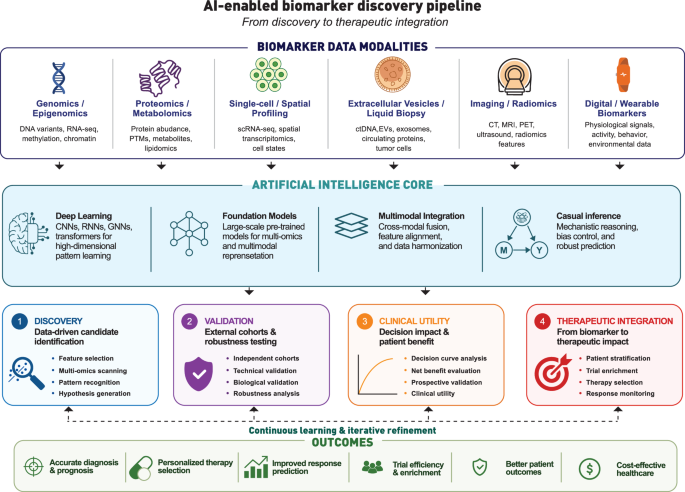
AI's Transformative Role in Uncovering Disease Biomarkers
Artificial intelligence is revolutionizing the discovery of disease biomarkers, moving beyond traditional single-modality analyses to integrate complex, multimodal biomedical data.
LTM Unveils BlueVerse SovereignSphere: Empowering Enterprises with Proprietary AI
LTM's new BlueVerse SovereignSphere Models allow enterprises to transform unique business knowledge into custom AI, ensuring data ownership and tailored intelligence.