Autonomous AI: The Core of Future Enterprise Intelligence
Enterprises are moving beyond fragmented AI tools towards autonomous, 'agentic' AI operating models to unlock true business value, requiring fundamental shifts in data strategy and infrastructure.

Enterprises are grappling with how to effectively scale artificial intelligence, realizing that success hinges on integrating AI not just as a tool, but as a foundational operating model.
The Unfolding Reality of Enterprise AI
Artificial intelligence has firmly established itself as a critical component of modern enterprise strategy, transcending its initial perception as a futuristic concept. Its capabilities are evolving rapidly, with new models and algorithms emerging at a pace that often outstrips an organization's capacity to integrate them fully. Concurrently, the financial barriers to entry for advanced AI solutions continue to decrease, making sophisticated tools more accessible. This dual trend has led to a significant surge in global AI investment, projected to reach an estimated $2.5 trillion by 2026, marking a substantial 44% increase from the preceding year.
Despite this considerable financial commitment and rapid technological advancement, many enterprises find themselves navigating a landscape of fragmented intelligence. AI applications frequently operate in isolation, creating data silos that impede a holistic view of business operations. For example, a sales team might lack visibility into customer support tickets, leading to inefficient or misinformed interactions. Similarly, marketing systems may personalize content without incorporating crucial financial insights about a customer, missing opportunities for more impactful engagement. While individual departmental AI initiatives might show promise, the enterprise as a whole struggles to synthesize these disparate pieces of information into cohesive, actionable intelligence. This lack of interconnectedness prevents organizations from truly leveraging their AI investments to drive broader strategic learning and decision-making.
The Agentic Shift: From Tools to Operating Models
The prevailing challenge for enterprises is not merely acquiring more powerful AI models or faster computational infrastructure. The critical transition lies in moving AI from being a collection of individual tools to becoming an integrated, autonomous operating model. This fundamental shift, often referred to as the “agentic shift,” demands a comprehensive re-evaluation of how an organization structures its people, processes, and data. It necessitates establishing real-time connections across these elements, underpinned by robust governance and control mechanisms to ensure reliable and responsible action based on AI-derived intelligence.
Achieving this agentic transformation requires a simultaneous overhaul of both technological architecture and operational paradigms. The first imperative is to reimagine data infrastructure, prioritizing accessibility and utility over sheer volume. Traditional data systems often focus on collecting vast amounts of information, but a truly intelligent enterprise requires data that is readily available and structured for AI consumption. Second, organizations must evolve beyond rigid, fixed technology stacks. The rapid evolution of AI models and tools means that static architectures quickly become obsolete. A composable architecture, built from interchangeable modules, offers the agility needed to adapt and integrate new capabilities as they emerge. Finally, enterprises must proactively address critical questions of AI sovereignty. This involves determining where AI intelligence resides, who maintains control over its functions, and how it operates seamlessly across various organizational divisions and jurisdictional boundaries, especially in a world with increasingly complex data residency and privacy regulations.
Structural Hurdles and Process-First Solutions
The challenges many enterprises face in scaling AI are often structural rather rather than technical. While global AI spending continues to climb and model capabilities advance rapidly, a significant number of organizations are not yet seeing commensurate increases in revenue or fundamental shifts in their operational approaches. The companies that are successfully generating sustained returns from their AI investments share a common characteristic: a disciplined, process-first methodology. These leaders understand that effective process redesign must precede model selection. Instead of retrofitting existing roles and workflows after an AI solution has been deployed, they proactively design their processes with an eye toward how the technology will evolve. For these forward-thinking organizations, the agentic shift begins not with the AI itself, but with a strategic re-evaluation and optimization of their core operating model.
This approach recognizes that AI is not a standalone solution, but an enabler of improved processes. By focusing on how AI can enhance, automate, or transform existing workflows, companies ensure that their technology investments are aligned with strategic business outcomes. This prevents the common pitfall of having powerful AI tools that lack clear integration into daily operations, or that address symptoms rather than underlying process inefficiencies. The process-first mindset lays the groundwork for AI to deliver truly transformative value, embedding intelligence directly into the organizational fabric rather than treating it as an ancillary function.
The Primacy of Data Readiness Over Abundance
A common misconception in enterprise AI is that having a large quantity of data automatically translates to AI readiness. Many organizations discover, often too late, that there is a significant difference between possessing vast data estates and having data that is properly prepared and structured for AI applications. The true value lies in data readiness, not merely data abundance. To effectively leverage AI, data must be clean, consistent, accessible, and organized in a way that AI agents can readily interpret and act upon. This often requires significant upfront work in data engineering and curation.
Building a sovereign, composable data foundation is crucial for converting raw data into actionable intelligence for AI agents. Such a foundation allows for querying and preparing data in its existing location, eliminating the need for costly and complex migration or centralized storage. This approach is particularly vital given the growing complexities of data residency laws, the proliferation of multicloud environments, and the inherent structural complexities of modern data landscapes. Centralizing all data is becoming increasingly impractical, both technically and legally. Maintaining sovereign control over where models run and where data resides ensures adaptability and compliance, allowing organizations to maximize the utility of their data while adhering to regulatory requirements and leveraging distributed data architectures. This strategic approach to data management transforms raw information into a compoundable asset, capable of fueling an ever-improving cycle of AI-driven insights and actions.
Redefining Enterprise Intelligence
Ultimately, the journey toward enterprise intelligence is about more than just deploying cutting-edge algorithms. It is about fundamentally redefining how organizations operate, learn, and adapt. The most successful enterprises are those that recognize AI as a transformative force requiring a holistic overhaul of their architectural and operational blueprints. This includes prioritizing process redesign, building composable data infrastructures, and establishing clear AI sovereignty. This comprehensive strategy enables organizations to move beyond fragmented AI initiatives toward a truly integrated, autonomous, and intelligent enterprise.
As highlighted by insights from MIT Technology Review, the agentic shift is not a future possibility but an ongoing evolution, demanding immediate strategic attention. It is a transition from isolated AI tools to an integrated operating model, where AI agents seamlessly connect data, processes, and people, driving continuous learning and dynamic action across the enterprise.
Why it matters
This shift to autonomous, agentic AI operating models profoundly impacts in-field AI, technicians, telco, and data center operations. For technicians, it means AI-driven diagnostics and predictive maintenance will become standard, requiring new skills in AI interaction and oversight rather than purely manual intervention. In telco, autonomous AI can optimize network performance, predict outages, and automate service provisioning, demanding robust, AI-ready network infrastructure. Data centers will become the backbone for this agentic shift, needing to scale compute and storage dynamically, manage complex data sovereignty requirements, and ensure low-latency connectivity to support real-time AI agents. The reliability and efficiency of these underlying infrastructures are paramount for the widespread adoption and success of enterprise-wide autonomous AI, making infrastructure a critical enabler of this next wave of intelligence.
More from Trends
RSSPLDT's Agentic AI Strategy Earns Top Recognition for Enterprise Transformation
PLDT, a leading Philippine digital services provider, has been honored with a Silver Award at the 2026 UiPath AI Breakthrough Awards for its innovative use of agentic AI to significantly enhance operational efficiency and empower its workforce.
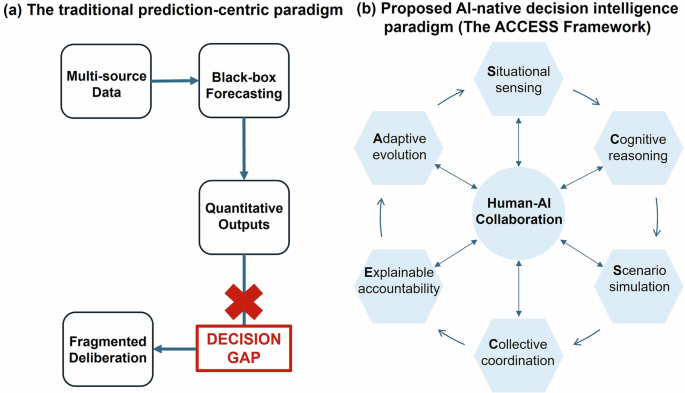
Revolutionizing Public Health: AI-Native Systems for Epidemic Response
Traditional epidemic early warning systems often fail to translate forecasts into timely action. A new framework, ACCESS, aims to integrate AI into every step of public health decision-making.

The Evolution of Predictive Analytics: From Insight to Autonomous Action
Predictive analytics is moving beyond simple forecasting, integrating deeply with AI to enable autonomous decision-making from complex data streams.
