Revolutionizing Public Health: AI-Native Systems for Epidemic Response
Traditional epidemic early warning systems often fail to translate forecasts into timely action. A new framework, ACCESS, aims to integrate AI into every step of public health decision-making.
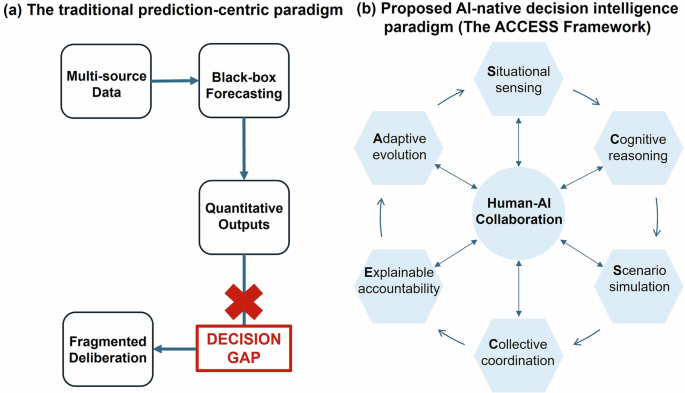
Epidemic early warning systems, traditionally focused on prediction, often fall short in enabling coordinated action, prompting a new AI-native framework for public health governance.
The Unresolved Disconnect in Epidemic Preparedness
For decades, epidemic early warning has been a cornerstone of global health security, driving surveillance and preparedness efforts against infectious diseases. Significant advancements in epidemiological modeling, statistical analysis, and data integration have vastly improved our capacity to detect outbreaks and forecast disease trajectories across various environments. Major public health emergencies, from SARS and influenza pandemics to the more recent COVID-19 crisis, have all benefited from these enhanced capabilities in situational awareness. However, despite these technological leaps, a critical limitation persists: a 'decision gap' where sophisticated forecasts and risk indicators frequently fail to translate into prompt, coordinated, and contextually appropriate action. This gap has been a recurring theme in global health crises, highlighting a fundamental disconnect between knowing and acting.
This decision gap manifests in two primary ways. Firstly, many forecasts are not designed for direct decision-making. They often lack the integration of operational constraints, conflicting objectives, or the presentation of uncertainty in a format that public health authorities can readily use. Secondly, institutions themselves must navigate complex processes to convert evolving evidence into actionable strategies, often constrained by legal frameworks and organizational structures. Existing systems offer limited support for this crucial translation. The consequences are not theoretical; retrospective analyses of the COVID-19 response reveal that the availability of forecasts was a poor predictor of response quality. Preparedness rankings showed minimal correlation with outcomes across numerous countries, and a misalignment between scientific evidence and policy decisions was a common failure point, rather than a mere absence of data. Even the forecasting community has acknowledged the limited real-world impact of COVID-19 forecasts, despite unprecedented data availability. This issue spans diverse institutional, political, and socio-economic contexts, suggesting a systemic rather than purely technical problem.
Shifting Focus from Prediction to Decision Intelligence
The prevailing perspective that frames epidemic early warning as a prediction-centric task directly contributes to this decision gap. Historically, early warning has primarily involved generating quantitative estimates, such as case trajectories, reproduction numbers, or risk scores, for subsequent use by decision-makers. However, public health decisions rarely depend solely on predictions. They demand structured reasoning under uncertainty, the integration of diverse evidence, and deliberation among multiple stakeholders with varying priorities, constraints, and responsibilities. An accurate forecast, if isolated from policy context, institutional mandates, and operational feasibility, does little to bridge the chasm between intelligence and effective intervention. During the COVID-19 pandemic, for instance, many jurisdictions struggled to align epidemiological insights with critical policy decisions on non-pharmaceutical interventions, resource allocation, and risk communication, leading to fragmented and delayed responses.
The core problem is not a lack of early signals or more precise forecasts, but rather the persistent failure to convert surveillance intelligence into legitimate, timely, and coordinated action. In current surveillance practices, risk indicators often necessitate extensive manual, cross-institutional interpretation before they can inform decisions. This introduces delays and inconsistencies precisely when speed and coherence are most vital. The proposed solution involves embedding evidence integration, uncertainty assessment, stakeholder coordination, and accountability directly into the design of early warning systems, rather than treating them as downstream manual tasks.
Introducing the ACCESS Framework
To address these challenges, a new conceptual framework, ACCESS, is being proposed. ACCESS reframes epidemic early warning not merely as prediction, but as the perceptual foundation for AI-native decision intelligence in public health governance. This framework integrates six critical components:
1. Situational Sensing: This involves real-time collection and integration of diverse data streams, from clinical reports and genomic sequencing to social media trends and mobility data. AI systems can enhance the detection of novel pathogens, identify unusual patterns, and provide a comprehensive picture of an evolving health threat. 2. Cognitive Reasoning: Beyond raw data, AI can be trained to interpret complex epidemiological patterns, identify causal links, and infer the potential impacts of interventions. This moves beyond simple forecasting to a deeper understanding of disease dynamics and public health implications. 3. Scenario Simulation: AI models can simulate various future scenarios based on different intervention strategies, disease mutations, or population behaviors. This allows decision-makers to explore the potential outcomes of their choices in a dynamic, data-driven environment, understanding trade-offs before committing to a course of action. 4. Collective Coordination: This element focuses on facilitating communication and collaboration among diverse stakeholders – public health officials, clinicians, policymakers, and community leaders. AI tools can help synthesize perspectives, identify consensus points, and highlight areas requiring further deliberation, ensuring that decisions are broadly understood and supported. 5. Explainable Accountability: A crucial aspect of trust in AI systems, this component ensures that the rationale behind AI-generated insights and recommendations is transparent and understandable. Decision-makers need to comprehend why a particular strategy is suggested and be able to defend their choices based on clear, attributable evidence. 6. Adaptive Evolution: Public health threats are constantly changing. The ACCESS framework emphasizes that AI systems must be designed to learn and adapt from new data, past interventions, and evolving epidemiological landscapes. This ensures that the early warning and decision intelligence system remains relevant and effective over time.
By prioritizing decision robustness, transparency, and human accountability over predictive accuracy alone, ACCESS aims to build a more resilient and responsive public health governance system.
AI's Role in Bridging the Action Gap
Recent breakthroughs in artificial intelligence, particularly with large language models, generative systems, and agent-based reasoning architectures, have expanded the capabilities of AI to support complex decision-making processes. These technologies can process vast amounts of unstructured data, understand nuanced contexts, and even simulate human-like reasoning, offering unprecedented potential to augment public health responses. For instance, large language models can quickly synthesize scientific literature, policy documents, and real-time news to provide comprehensive situational awareness. Generative AI could assist in drafting communication strategies or operational plans, tailored to specific populations or crisis phases. Agent-based models can simulate the interactions of individuals and organizations within an epidemic scenario, helping to understand the potential impact of various social and behavioral interventions.
Instead of simply presenting a forecast, an AI-native decision intelligence system integrated into ACCESS would act as an intelligent assistant, helping public health leaders evaluate evidence, understand operational constraints, reconcile conflicting objectives, and deliberate with stakeholders. This kind of system would not replace human decision-makers but would empower them with richer insights, more thoroughly vetted options, and a clearer understanding of potential consequences. The goal is to create a seamless flow from data sensing to coordinated, accountable action, ensuring that valuable insights are not lost in translation or bogged down by manual processes.
This evolution represents a significant paradigm shift from viewing AI as a mere forecasting tool to envisioning it as an integral part of a holistic decision support ecosystem. It moves beyond the traditional focus on what might happen to an emphasis on what should be done and how it can be achieved effectively and ethically. As outlined in the journal Nature, this reframing is essential for building public health systems that are truly resilient and responsive to future threats.
Why it matters
The transition to AI-native decision intelligence for public health has profound implications across multiple sectors. For in-field AI and technicians, it necessitates the development of robust, ethical, and explainable AI models capable of handling complex, real-time public health data. This includes advancements in data integration, privacy-preserving AI, and human-in-the-loop validation systems. For telecommunications providers, it underscores the need for high-speed, reliable network infrastructure to transmit vast amounts of health data from diverse sources, supporting edge computing and decentralized AI processing. Data center operations will be critical for housing and processing the immense datasets required for these AI systems, demanding scalable, secure, and energy-efficient architectures. Ultimately, a more effective global epidemic early warning and response system, powered by integrated AI, protects not just public health but also the global economy and critical infrastructure by mitigating the disruptive impacts of future pandemics. This framework emphasizes that technological prowess must be coupled with human-centric design and governance to achieve true societal resilience.
More from Trends
RSSPLDT's Agentic AI Strategy Earns Top Recognition for Enterprise Transformation
PLDT, a leading Philippine digital services provider, has been honored with a Silver Award at the 2026 UiPath AI Breakthrough Awards for its innovative use of agentic AI to significantly enhance operational efficiency and empower its workforce.

Autonomous AI: The Core of Future Enterprise Intelligence
Enterprises are moving beyond fragmented AI tools towards autonomous, 'agentic' AI operating models to unlock true business value, requiring fundamental shifts in data strategy and infrastructure.

The Evolution of Predictive Analytics: From Insight to Autonomous Action
Predictive analytics is moving beyond simple forecasting, integrating deeply with AI to enable autonomous decision-making from complex data streams.
