Humanoid Robots to Fill Service Gap in Future Public Transport
As autonomous vehicles replace human staff in public transport, humanoid robots could step in to provide essential passenger assistance and safety, enhancing inclusivi
Autonomous public transport is on the horizon, promising increased efficiency but simultaneously creating a critical void in human assistance. Humanoid robots are being proposed as a novel solution to bridge this gap, restoring essential passenger support and safety functions in automated transit systems.
The Looming Service Gap in Autonomous Transit
The public transport sector is undergoing a significant transformation, primarily driven by the anticipated adoption of autonomous vehicles. These self-driving systems are expected to deliver enhanced efficiency and operational flexibility. However, this advancement comes with a substantial consequence: the removal of the human element. Today, vehicle operators fulfill numerous roles beyond driving, including assisting passengers, managing boarding procedures, disseminating information, and ensuring safety. In fully automated environments, these crucial tasks will no longer be performed, creating a significant service void.
Compounding this challenge are several demographic and social trends. Many industrialized nations face aging populations, leading to an increased demand for assistance within transport systems, whether for ticketing, boarding, or understanding real-time travel information. Furthermore, there is a broader societal push for public transport to be more inclusive and accessible to diverse user groups, including individuals with disabilities or language barriers. Simultaneously, the sector grapples with severe personnel shortages. Transit agencies worldwide report difficulties in recruiting and retaining frontline staff, resulting in a reduction or elimination of basic passenger assistance services. This exacerbates the growing disparity between passenger needs and available service provisions.
Humanoid Robots as a Solution
To address this emerging service gap, the integration of humanoid robots is being proposed. These autonomous, human-like machines are designed to interact physically and communicate socially. Their key strength lies in their compatibility with existing human-centric environments. Humanoid robots can navigate spaces built for people, such as stations with stairs and doors, and adapt in real time to dynamic situations, such as unexpected obstacles or spontaneous task requirements. This inherent flexibility distinguishes them from conventional robotic systems, positioning them as a vital component for the next phase of automation, particularly in complex and unpredictable operational settings.
Recent advancements in artificial intelligence (AI) and robotics have made it possible for such systems to function effectively as guides, helpers, or assistants within transit environments. They can navigate crowded areas, communicate naturally with users, and offer reliable assistance in scenarios where human presence is absent. This visionary perspective highlights the potential contributions of humanoid robots to future public transport systems, aiming to stimulate further discussion and research in this evolving field. While some concepts may appear ambitious, the goal is to explore how these robots can contribute to more user-friendly, efficient, and accessible mobility concepts.
Understanding Robot Classifications
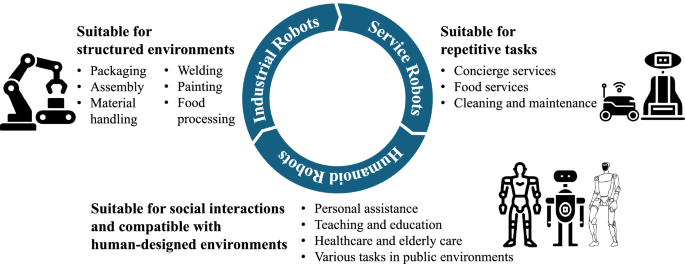
Robots have been integral to various industries for decades, from manufacturing to logistics and even healthcare. For the purpose of understanding their application in public transport, robots can be broadly classified into three categories based on their form, function, and primary application:
- Industrial Robots: These are specialized machines primarily used in manufacturing. They excel at repetitive and physically demanding tasks like welding, assembly, or packaging, typically operating in structured, often isolated, environments. Over time, they have evolved from stationary units to mobile robots that can collaborate with human workers.
- Service Robots: Designed to operate in environments with human interaction, service robots provide support in various settings including households, healthcare, and hospitality. They are built to respond flexibly to human needs and can be social, offering information or companionship, or non-social, performing tasks like cleaning or lawn mowing.
- Humanoid Robots: Distinguished by their human-like form, typically possessing a head, torso, two arms, and two legs. This design enables them to seamlessly move through environments designed for people. Equipped with advanced sensors, cameras, and AI, humanoid robots can recognize faces, understand speech, and even detect or respond to human emotional cues. Their development, which began in the 1970s, has progressed significantly, transforming them into intelligent systems capable of human-like attributes. This makes them particularly well-suited for roles in public transport, where they can assist passengers, facilitate boarding, and enhance safety across platforms.
The Path Ahead: Challenges and Implications
While the technical feasibility of humanoid robots in public transport is advancing, their successful integration will necessitate addressing broader societal, legal, and organizational challenges. The vision outlined by Nature acknowledges that the implementation requires careful consideration beyond purely technological aspects. This includes navigating public acceptance, establishing clear regulatory frameworks, and understanding the organizational restructuring that such an integration would entail. The pace and direction of technological and societal change remain uncertain, making this an evolving and potentially transformative area within transportation engineering.
Why it matters
For the AI, telecommunications, and data center sectors, the advent of humanoid robots in public transport represents a significant demand driver and an intricate integration challenge. These robots will rely heavily on robust AI for perception, navigation, decision-making, and natural language processing. Real-time operation in dynamic public spaces will necessitate ultra-low latency connectivity, pushing the boundaries of 5G and future telecommunications infrastructure. Furthermore, the constant stream of sensor data and operational analytics generated by these robots will require extensive processing capabilities, leading to increased demand for edge computing solutions and advanced data center resources. Technicians in these fields will be crucial for developing, deploying, and maintaining the complex interconnected systems that enable humanoid robots to function effectively and safely within public transport networks. This convergence of robotics, AI, and advanced infrastructure highlights a critical future growth area for the industry.
More from Trends
RSS
AI Agents on the Horizon: Milestones for Widespread Adoption
AI agents are poised to become ubiquitous, but three critical milestones must be met: transforming software development, establishing trust through verification, and democratizing agent creation.
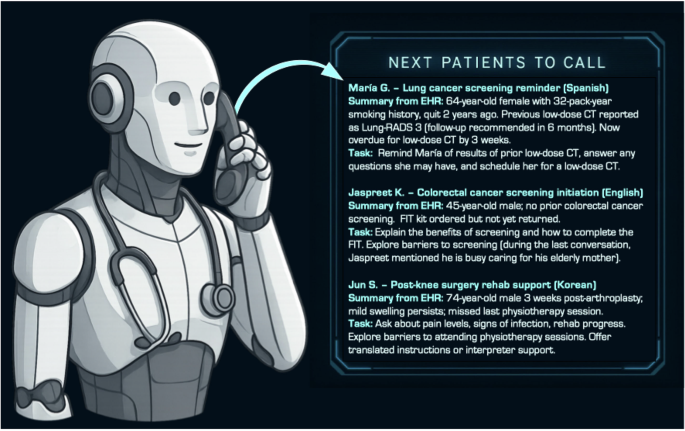
Voice AI Set to Reshape Healthcare Communication
Generative AI voice agents, leveraging large language models, are poised to revolutionize patient engagement and administrative tasks within healthcare.

DeepMind's Nobel Recognition: A Catalyst for New Scientific Frontiers
Google DeepMind's AlphaFold, a protein-folding AI, has earned a Nobel Prize, sparking discussion about AI's role in fundamental scientific breakthroughs.