Terahertz Cell-Free Networks Harness AI to Power the Metaverse
New research introduces a novel network architecture combining Terahertz communication, cell-free MIMO, and AI-driven mobile edge computing to meet the extreme demands of the Metaverse.
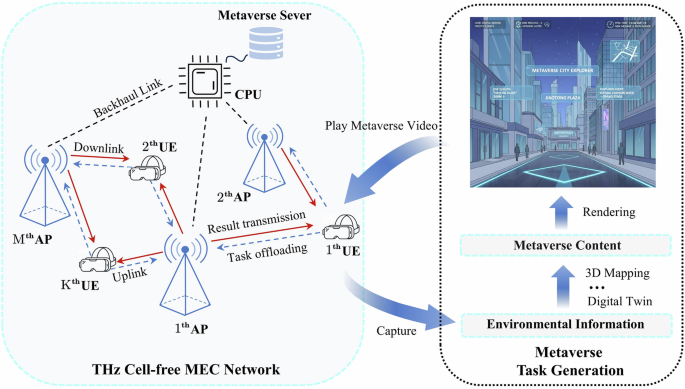
To address the immersive and computational needs of the Metaverse, researchers have developed a Terahertz cell-free mobile edge computing network, utilizing a multi-agent AI approach for optimized resource allocation and significantly improved performance over traditional systems.
The Metaverse's Demands on Future Networks
The Metaverse is rapidly taking shape as the next evolution of the internet, promising truly immersive and interactive digital experiences that blur the lines between the physical and virtual worlds. This ambitious vision is underpinned by a fusion of advanced technologies, including the Internet of Things (IoT), digital twins, and artificial intelligence (AI). While offering immense potential in areas like augmented reality (AR) and sophisticated online gaming, the Metaverse presents unprecedented technical challenges, particularly for forthcoming sixth-generation (6G) communication networks. The sheer complexity of rendering immersive content necessitates extensive computational power, which often exceeds the capabilities and battery life of typical user equipment (UE). Mobile Edge Computing (MEC) has emerged as a crucial strategy to overcome these limitations. By offloading demanding computational tasks to network edge servers, MEC significantly reduces both latency and energy consumption for end-users, facilitating higher quality experiences.
However, the computational load is only one facet of the challenge. High-fidelity Metaverse video streams require data transmission rates in the multi-Gigabits per second range, far surpassing the capacity of current cellular networks. To meet these rigorous data throughput and connectivity demands, Terahertz (THz) communication is being explored. THz frequencies offer multi-gigahertz bandwidth, making them ideally suited for transferring vast amounts of data. Despite this advantage, THz signals are highly susceptible to obstruction and experience significant signal loss over distance. Prior studies have investigated THz-enabled MEC for AR services, but they often struggle with traditional network architectures that cannot guarantee the robust reliability essential for seamless Metaverse interactions. This is where cell-free multiple-input multiple-output (MIMO) networks offer a compelling solution. By coordinating numerous distributed access points (APs) to serve users simultaneously, cell-free networks effectively mitigate blockage issues and shorten the communication path for THz signals. Consequently, the combination of THz communication and cell-free networks forms a powerful foundation for MEC systems capable of supporting advanced Metaverse applications.
Integrating Advanced Technologies for Enhanced Performance
The convergence of THz communication, cell-free MIMO networks, and MEC represents a transformative paradigm: the THz Cell-free MEC network. This innovative architecture holds significant promise for supporting the rigorous requirements of Metaverse applications, which are characterized by ultra-low latency, minimal energy consumption, substantial computing resource needs, and massive data transmission volumes. Despite the inherent potential of this integrated system, a critical research gap pertains to the efficient, long-term management of its complex network resources. The core challenge lies in the joint optimization problem of task offloading decisions, communication resource allocation, and computing resource allocation, which is known to be NP-hard. The intricate interplay between user devices and access points further complicates this optimization task. Additionally, the dynamic nature of the network introduces another layer of complexity. THz channels are inherently volatile, subject to changes in the line-of-sight probability due to environmental shifts. Moreover, the size of Metaverse tasks generated by each user can vary across different time intervals, leading to fluctuating demands for communication and computation resources. Traditional optimization methods, such as convex optimization or game theory, typically fall short in dynamic, real-time environments, often incurring prohibitive computational costs for such complex and dynamic systems.
The Role of Multi-Agent AI in Resource Management
To overcome the significant challenges associated with dynamic resource allocation in THz cell-free MEC networks, researchers have turned to artificial intelligence, specifically multi-agent reinforcement learning (MARL). The task of efficiently managing task offloading and resource allocation in such complex, dynamic environments is conceptually akin to training multiple agents to make intelligent decisions collaboratively. The decentralized and collaborative nature of MARL is particularly well-suited for scenarios where multiple base stations or access points need to make coordinated decisions to optimize system performance. This approach allows each agent (e.g., an access point or a cluster of them) to learn optimal strategies for managing its local resources while considering the actions and states of other agents in the network. This collective intelligence is crucial for handling the intricacies of an NP-hard optimization problem in real-time. By leveraging MARL, the system can adapt to changes in user demand, network conditions, and THz channel characteristics, ensuring a consistently high quality of service for Metaverse applications.
Specifically, a multi-agent proximal policy optimization (MAPPO) algorithm was developed to tackle this challenge. MAPPO is a sophisticated reinforcement learning technique that enables multiple agents to learn how to achieve a long-term optimal balance between energy consumption and latency. This multi-agent architecture is adept at modeling the deeply interconnected decision variables inherent in the network, where the choice of offloading a task to a particular edge server impacts not only communication resources but also computational load and overall network energy footprint. A key innovation in this design is the use of Beta and Dirichlet distributions for parametrizing the action space. This mathematical technique ensures that the AI agents' decisions strictly adhere to the physical constraints of the network, preventing unrealistic or impossible resource allocations. For example, it ensures that bandwidth or processing power allocations do not exceed the actual capacity of the system. This meticulous design allows the MAPPO algorithm to make practical and effective decisions within the highly constrained environment of a cutting-edge communication network.
Performance and Advantages Over Conventional Systems
Extensive simulations were conducted to evaluate the efficacy of the proposed MAPPO algorithm within the THz cell-free MEC network. The results demonstrated that under identical conditions and training durations, MAPPO consistently achieved stable convergence, indicating its robustness and reliability in learning optimal strategies. Critically, MAPPO significantly outperformed other established multi-agent deep reinforcement learning (MADRL) baselines, including MADDPG (Multi-Agent Deep Deterministic Policy Gradient) and MATD3 (Multi-Agent Twin Delayed Deep Deterministic Policy Gradient). This superior performance highlights MAPPO's ability to navigate the complex decision-making landscape of the network more effectively, leading to better resource utilization and overall system efficiency.
Beyond comparison with other AI methods, the research revealed that the entire architecture – the THz cell-free MEC network powered by MAPPO – delivered substantial improvements over traditional cellular and small-cell systems. The combination of high-bandwidth THz communication, the extended coverage and reliability of cell-free MIMO, and the intelligent, adaptive resource management by the AI system creates a network environment that is far better equipped to handle the extreme demands of the Metaverse. Users can expect lower latency, reduced energy consumption for their devices, and a more seamless, immersive experience. The ability to dynamically adapt to varying conditions, from changes in network load to environmental interferences affecting THz signals, ensures that the network remains performant and reliable, crucial for applications where even milliseconds of delay can degrade the user experience. This advancement represents a significant step towards realizing the full potential of next-generation immersive technologies, as detailed in Nature's npj Wireless Technology journal.
Why it matters
This research is particularly relevant for the AI, telecommunications, and data centre industries. For telco operators, it presents a tangible roadmap for upgrading existing infrastructure towards 6G capabilities, specifically addressing the critical demands of emerging immersive applications like the Metaverse. The implementation of THz cell-free MEC networks, managed by advanced AI like MAPPO, promises to revolutionize network efficiency by optimizing resource allocation and minimizing latency and energy consumption. This directly translates to improved quality of experience for end-users, a key differentiator in a competitive market. For data centre operations and AI infrastructure, the ability to intelligently offload and process computationally intensive tasks at the network edge means a more distributed and efficient computing paradigm. This could lead to new architectures for edge data centers and novel approaches to managing the computational demands of AI inference in real-time. Field technicians will also see new challenges and opportunities, requiring specialized skills for deploying and maintaining THz antenna arrays and advanced edge computing nodes. Ultimately, this work underscores how AI is becoming indispensable for managing the complexity of future communication networks, ensuring reliable and high-performance services.
More from Trends
RSSNew AI Model Enhances Medical Image Diagnosis with Hierarchical Attention
Researchers have developed an advanced AI model, based on the Swin Transformer, to significantly improve the accuracy of medical image classification by focusing on diverse feature levels, from macro-scale lesions to minute anatomical details.

Caterpillar Leverages Decades of Automation Experience for Broad AI Deployment
Caterpillar, a veteran in industrial automation, is applying its extensive experience from automating mining operations to the wider deployment of artificial intelligence across its products and internal processes.

Humanoid Robots: Evolution Beyond Expectation
The future of humanoid robots is unfolding in ways few predicted, moving past science fiction ideals to find practical applications in diverse sectors.
