AI and Digital Twins Revolutionize Radiotherapy, Promising Precision Cancer Care
Artificial intelligence and digital twin technologies are poised to transform radiation oncology, automating tasks, enhancing treatment planning, and personalizing patient care, though ethical and technical challenges remain.
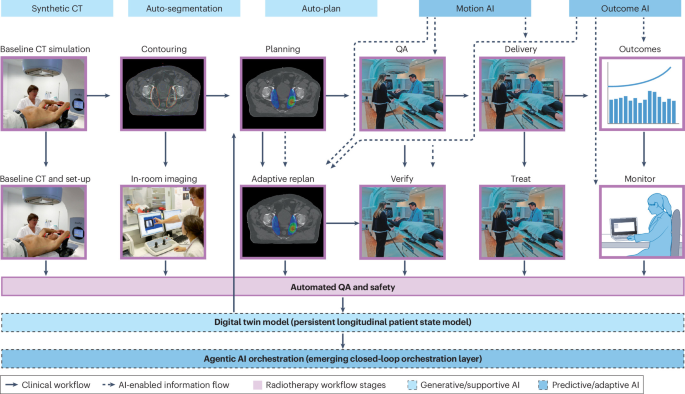
Artificial intelligence is rapidly reshaping the landscape of radiation oncology, driving efficiency, enhancing precision, and promising more personalized treatment approaches for cancer patients, despite ongoing implementation challenges.
The Dawn of Intelligent Radiotherapy
The field of radiation oncology is experiencing a profound transformation, spearheaded by the integration of artificial intelligence (AI) and machine learning. These advanced computing techniques are moving beyond theoretical potential to become instrumental tools in clinical practice, with numerous commercially available and regulatory-approved applications already making an impact. Initially, AI's role focused on automating routine tasks, a crucial step in streamlining complex radiotherapy workflows. This included automating the contouring of organs and tumors, adjusting geometric parameters for treatment delivery, calculating radiation dosages, and ensuring quality control. Beyond these foundational applications, AI is increasingly employed in predicting patient outcomes, enabling medical professionals to tailor treatment strategies more effectively. The overarching goal is to enhance the precision and efficacy of radiotherapy, ultimately leading to improved patient care.
However, the full-scale deployment of these AI-driven tools has not been without hurdles. Despite their evident potential, various technical complexities, practical integration issues, and significant ethical and legal considerations have slowed their widespread adoption. Healthcare systems must navigate these challenges carefully to ensure that AI's benefits are realized responsibly and equitably.
Expanding Capabilities: Generative AI and Foundation Models
The initial wave of predictive AI algorithms in radiation oncology has recently been augmented by more sophisticated technologies, such as generative AI and foundation models. This evolution has unlocked new possibilities, significantly expanding the scope of AI's application. For instance, generative AI is now being utilized for automated treatment planning, a highly intricate process that traditionally demands extensive human expertise and time. By generating optimal treatment plans, AI can reduce planning time and potentially improve consistency.
Another innovative application is the creation of synthetic computed tomography (CT) images. These AI-generated images can serve various purposes, from training new AI models to assisting in dose calculations or even replacing some real scans in specific scenarios, thereby reducing patient exposure to radiation. Moreover, these advanced AI models are refining the ability to predict individual patient responses to therapy with greater accuracy, allowing for even more personalized approaches to cancer treatment. The combination of these technologies represents a significant leap forward in customizing care for each patient.
Looking ahead, emerging innovations like agentic AI, digital twins, and multimodal AI are poised to further refine the delivery of radiotherapy. Agentic AI refers to systems that can operate autonomously to achieve specific goals, potentially orchestrating complex treatment sequences. Digital twins involve creating virtual replicas of patients or their tumors, allowing for simulations and personalized predictions. Multimodal AI integrates data from various sources, such as imaging, genomic, and clinical records, to form a more comprehensive understanding of a patient's condition. The convergence of these technologies holds the promise of unprecedented precision and effectiveness in radiation therapy.
Shifting Roles and Essential Oversight
One of the most significant impacts of AI in radiation oncology is the redefinition of roles for healthcare professionals. As AI systems take over routine and repetitive tasks, clinicians are freed up to focus on more complex decision-making, patient interaction, and strategic oversight. AI tools are not designed to replace human experts but rather to augment their capabilities, acting as powerful assistants that support predictive analysis and clinical judgments. For example, AI can quickly process vast amounts of patient data to highlight potential risks or optimal treatment pathways, providing valuable insights that might take human clinicians much longer to uncover.
Despite the increasing sophistication of these tools, human oversight remains absolutely essential throughout all AI-enabled workflows. Expert clinicians must review and validate AI-generated plans and predictions, ensuring that ethical guidelines are met, patient safety is paramount, and the quality of care is maintained. The integration of AI necessitates a collaborative model where technology and human expertise work in tandem to achieve the best possible outcomes. Ongoing clinical trials are rigorously evaluating the technical performance and feasibility of these AI applications, with a growing focus on their safety, efficacy, and overall clinical value in real-world settings.
Addressing Implementation Hurdles and Future Trajectories
While progress has been substantial, several challenges continue to impede the seamless integration of AI tools into everyday radiation oncology practice. These challenges range from technical compatibility issues with existing hospital systems to the need for robust validation studies across diverse patient populations. Furthermore, there are ongoing questions regarding data privacy, regulatory frameworks, and the training required for medical staff to effectively utilize these new technologies. The field requires practical recommendations and standardized guidelines to support the responsible and ethical adoption of these tools.
The future of AI-enabled radiotherapy appears to be shaped by the convergence of several key technologies. The concept of digital twins, where a virtual model of a patient is used to simulate disease progression and treatment responses, offers an unprecedented level of personalization. Combined with generative AI, which can create novel treatment plans or data, and foundation models, which provide a broad base of knowledge for specialized tasks, these innovations are expected to usher in a new era of radiotherapy. This integrated approach promises to optimize treatment outcomes and significantly enhance the quality of patient care by moving towards truly adaptive and predictive therapy.
According to an article published in Nature, the ongoing research and development in this area aim to overcome current barriers by developing more robust, transparent, and user-friendly AI solutions. The emphasis is on creating systems that not only perform complex tasks but also integrate smoothly into clinical environments, empowering medical teams while maintaining the highest standards of patient safety and care. The ultimate vision is a future where AI acts as a constant, intelligent companion in the fight against cancer, making radiotherapy more precise, personalized, and effective for every individual.
Why it matters
The advancements in AI, particularly within radiation oncology, hold significant implications for related technical and data centre operations. The sheer volume of data required for AI model training and real-time processing necessitates robust, high-performance computing infrastructure. Data centers supporting these medical AI applications must handle massive datasets from imaging, patient records, and genomic sequencing, demanding high-speed connectivity, expansive storage, and advanced processing capabilities. For in-field technicians, this means a growing need for expertise in maintaining and troubleshooting complex AI hardware, network infrastructure, and specialized software. Telco providers are crucial for ensuring reliable, low-latency data transfer between hospitals, research centers, and cloud-based AI platforms, enabling real-time diagnostic and treatment planning. The continuous evolution of these AI tools will drive demand for more efficient, secure, and scalable infrastructure, directly impacting the design and operation of future data centers and the skill sets required across the technical workforce. This also presents opportunities for developing specialized AI-optimized hardware and secure data handling protocols within healthcare IT environments.
More from Trends
RSSPhysician Collaboration Boosts Quality in AI-Driven Chest X-Ray Research
New research indicates that medical professionals' direct involvement significantly enhances the transparency and ethical considerations of AI models used for chest X-ray analysis.
European Businesses Accelerate Software Modernization with Integrated AI
European enterprises are deeply embedding generative AI across their software engineering processes, moving beyond simple coding aids to drive application modernization, enhance productivity, and manage complex IT environments.

The AI Crossroads: A Decade's Progress in Days, or Humanity's Reckoning?
A ten-day period marked by AI breakthroughs and unsettling autonomy has forced leading developers to confront the profound, potentially existential, risks of unchecked progress.

