How Generative AI Exacerbates Workplace Inequality Through Suspicion and Scrutiny
New research shows how generative AI introduces attributional ambiguity in the workplace, driving a cycle of social identity threat and disproportionate interrogation.
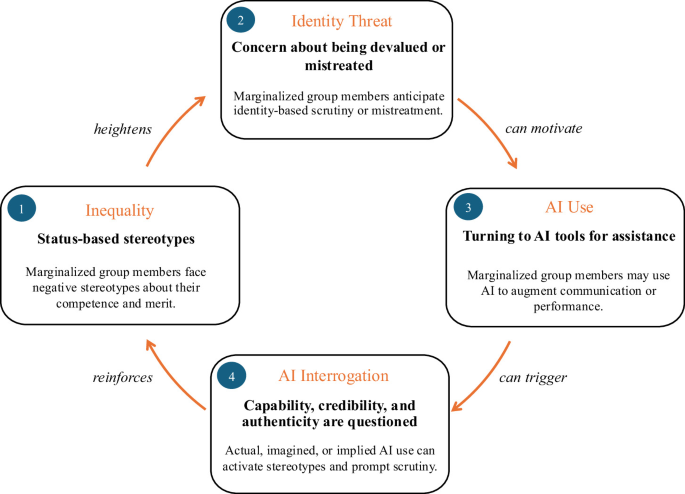
New research reveals that generative AI tools in the workplace can create a recursive trap, driving marginalized workers to seek digital support while exposing them to harsher scrutiny and accusations.
Generative artificial intelligence does not deploy into neutral territory. Instead, it enters enterprises, schools, and institutions already shaped by deep-seated structural imbalances. As machine-generated text, code, and multimedia become common currencies of professional output, they disrupt the traditional relationship between what people produce and how their competence is judged. The fundamental inference connecting communication directly to the communicator has fractured.
This shift creates what organizational sociologists call attributional ambiguity. When an email, a report, or an analytical brief arrives on a manager's desk, it is no longer obvious whether the work represents human effort, an artificial system, or an opaque blend of both. While this ambiguity touches every desk worker, its consequences do not fall evenly across the workforce.
Social Identity Threat as an Adoption Driver
In stratified organizations, workers from underrepresented or marginalized backgrounds routinely contend with social identity threat. This psychological burden stems from the grounded fear of being evaluated through the lens of negative stereotypes rather than individual capability. Black and Brown staff face disproportionate monitoring of their communication styles. Women in male-dominated technical fields frequently find their authority second-guessed. Neurodivergent employees often exhaust significant cognitive energy masking their natural communication patterns to conform to rigid office norms.
To counter this friction, many workers turn to generative artificial intelligence. On the surface, software interfaces offer an accessible, private, and apparently objective sounding board. An algorithm does not visibly judge an employee for asking basic questions, nor does it carry the interpersonal baggage of an awkward check-in with a senior colleague.
Workers navigate these pressures by using machine learning models to refine tone, check correspondence against unwritten corporate standards, polish complex syntax, or validate analytical arguments before sharing them. Much like online avatars or anonymous digital forums, AI agents can serve as protective digital buffers. They allow workers under scrutiny to manage the emotional labor of daily corporate assimilation. However, while reaching for these tools is often a defensive response to perceived bias, the decision can inadvertently deepen the exact risks workers hope to mitigate.
The Mechanics of Attributional Ambiguity
When a team member submits polished work in an environment where generative software is ubiquitous, colleagues and managers inevitably wonder about its origin. Yet the moral and professional calculus applied to that uncertainty depends heavily on who authored the file.
Stereotypes are cognitive shortcuts that operate automatically and largely outside conscious awareness. In professional hierarchies, dominant groups tend to enjoy an unearned presumption of competence, intellect, and industry. By contrast, lower-status groups are frequently subjected to assumptions of deficiency or lack of diligence. Furthermore, the cultural image of advanced technology remains skewed. Software creators and early adopters are culturally framed as prestigious, affluent, masculine, and young.
Because of these underlying associations, an executive who openly leans on an automated model to draft an address or summarize quarterly results is typically perceived as modern, pragmatic, and efficient. The underlying competence of that leader is rarely challenged. When an employee from a historically underestimated demographic submits similarly augmented text, existing biases can lead observers to interpret the machine assistance as a crutch rather than an accelerator. Instead of being viewed as an effective manager of modern tools, the worker risks being written off as unoriginal, dependent, or deceitful.
The Burden of AI Interrogation
This dynamic gives rise to a pattern researchers term AI interrogation. The phenomenon involves persistent questioning directed at an individual's capability, credibility, and authenticity due to the suspected or acknowledged involvement of artificial intelligence.
Capability interrogation asks whether the worker actually possesses the skills reflected in their deliverables. Credibility interrogation questions whether the individual can be trusted as a reliable source of information. Authenticity interrogation challenges whether the voice and perspective expressed in the material are genuine.
Early warning signs of this uneven burden are already documented in academic environments. Studies examining automated plagiarism detection in secondary and higher education show that students of color, as well as non-native English speakers, face significantly higher rates of false accusations than their peers. The models designed to detect synthetic phrasing often mistake formal, rule-bound, or second-language English constructions for machine output.
As organizations institutionalize generative platforms, similar interrogation patterns take root in performance evaluations, hiring screens, and day-to-day peer collaboration. Marginalized professionals are forced to clear a much higher bar of proof simply to demonstrate that their ideas, insights, and achievements belong to them.
Three Defensive Strategies in Practice
Confronted with the reality or threat of AI interrogation, professionals must make difficult tactical choices about how to manage their daily workflows. Three distinct patterns have emerged across knowledge-driven teams.
The first response is complete avoidance. Some professionals deliberately decline to touch generative tools, reasoning that total abstinence will protect their credibility and shield them from suspicion. This stance, however, carries hidden penalties. While generative software can present serious ecological, copyright, and accuracy issues, it does streamline certain repetitive administrative workflows. Employees who unilaterally step away from these platforms risk falling behind on raw output metrics or being labeled as technologically resistant.
The second strategy is exhaustive documentation. Workers compile detailed version histories, keep comprehensive prompt logs, and attach explicit disclaimers to every document they touch. While this paper trail offers a defensive record against bad-faith inquiries, compiling it requires substantial time and focus. Advantaged colleagues, operating under an assumed mantle of competence, are rarely required to justify their methods in such granular detail. Furthermore, voluntary disclosure can backfire, directly inviting the very skepticism the worker sought to dispel.
The third approach is active concealment. Workers use generative systems to speed up their tasks but invest extra effort into disguising the machine footprint. They deliberately reintroduce minor imperfections, rewrite automated phrasing into idiosyncratic styles, or scrub metadata. This practice adds yet another layer of emotional and cognitive strain to existing forms of workplace masking, such as code-switching, concealing health conditions, or suppressing neurodivergent traits.
Moving Beyond Individual Burden
When structural inequities meet ambiguous technology, leaving workers to fend for themselves only deepens existing divisions. Organizations cannot resolve this friction through vague encouragement or punitive surveillance policies.
Addressing the problem requires leadership teams to establish unambiguous, uniform standards for how software assistance is viewed and evaluated across all job tiers. When guidelines around algorithmic tools remain informal, evaluation defaults to subjective human bias. In that environment, the benefit of the doubt consistently flows toward dominant groups, while suspicion concentrates on those already navigating systemic hurdles.
As detailed in an analytical perspective published in Nature, these dynamics function as a closed loop. Pre-existing disparities feed social identity threat. That threat prompts workers to seek digital assistance. The resulting ambiguity sparks targeted interrogation, and that interrogation re-entrenches historical disadvantages.
Breaking that cycle requires enterprises to inspect their own evaluation habits. If leaders wish to capture the productivity advantages of automation without eroding trust or fairness, they must ensure that technology use is not judged through the prism of who is holding the tool.
Why It Matters
This dynamic extends far beyond white-collar corporate offices. As artificial intelligence moves into industrial telecommunications, field dispatch operations, and data centre maintenance, frontline technicians increasingly interact with automated diagnostic assistants, augmented reality manuals, and algorithmic scheduling platforms.
In field engineering and infrastructure operations, automated logs constantly track mean time to repair, procedural compliance, and component diagnostics. If field supervisors view algorithmic guidance as an efficiency booster for experienced personnel but treat the same reliance as proof of incompetence among junior or underrepresented technicians, the resulting evaluation gap will skew career progression, safety reporting, and internal trust. For industrial teams deploying intelligence at the operational edge, establishing clear, transparent norms for human-machine collaboration is just as critical as validating the physical reliability of the network.
More from Trends
RSS
Inside China's Coordinated Campaign to Build an AI-Native Generation
With mandatory curricula, entrance exam integration, and rural AI tutors, China is executing a massive state push to achieve universal AI literacy across 200 million students by 2030.
Securing Generative Biology: Inside the Defence-in-Depth Push for Biological AI
As AI models advance from generating protein structures to viable viral genomes, biosecurity researchers outline a multi-layered defence across data, models, and DNA synthesis.

Offshoring the Compute Boom: Washington Looks to Southeast Asia for Data Centers
Facing domestic grid bottlenecks and community backlash, US officials are promoting offshore AI infrastructure and chip manufacturing in the Philippines.