Mapping the True Carbon Footprint of 403 Hyperscale Data Centres
A granular audit of 403 US hyperscale facilities reveals they consume 82 TWh annually, drawing over half their power from fossil fuels despite corporate green pledges.
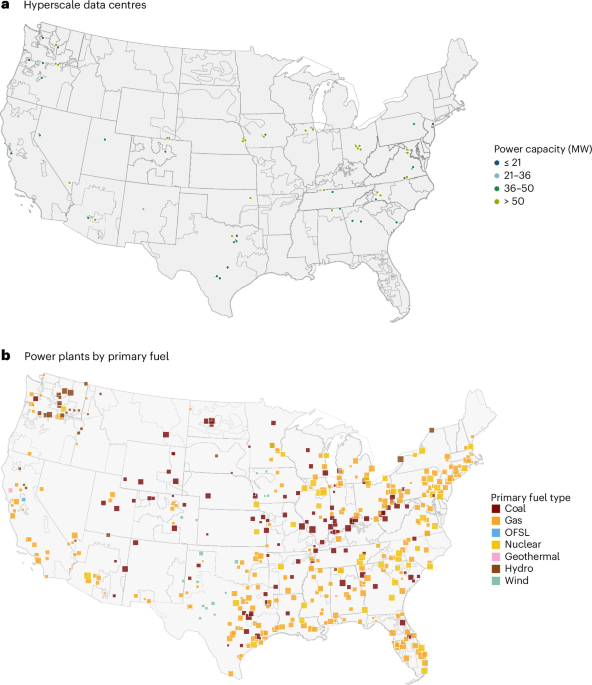
A granular analysis of 403 US hyperscale data centres reveals they consume roughly 82 terawatt-hours of electricity annually, generating 25.7 million metric tons of carbon emissions while leaning heavily on fossil fuels.
Mapping the Physical Footprint of the AI Boom
For years, discussions about the environmental cost of artificial intelligence have relied on broad national projections, corporate sustainability reports, and educated guesswork. As technology giants race to deploy clusters of power-hungry graphics processors, data centres have transformed from nondescript industrial warehouses into some of the most energy-dense facilities on the planet. Yet, tracking their exact strain on local power grids has remained notoriously difficult because operators often treat power consumption, site-level hardware configurations, and exact coordinates as proprietary trade secrets.
To bridge this information gap, researchers compiled and evaluated facility-level data across 403 operational hyperscale data centres in the contiguous United States between May 2024 and April 2025. Rather than treating data centres as an amorphous national aggregate, the study pinned down specific sites and mapped them directly against local balancing authorities and power plant dispatch data.
The findings provide the clearest empirical baseline yet for how hyperscale cloud computing and generative AI workloads impact the electric grid. By evaluating the actual generating assets supplying power to these campuses, the research strips away promotional marketing and demonstrates the direct operational realities of the modern computing boom.
The Raw Numbers: Terawatt-Hours and Megatons
Across multiple operating scenarios designed to reflect varying hardware workloads, the 403 examined hyperscale facilities were found to consume between 68 and 99 terawatt-hours of electricity over the course of a single year. Under the study's central load scenario, which models an average facility utilisation rate of roughly 58 percent, power demand totaled approximately 82 terawatt-hours.
To place that number in context, 82 terawatt-hours accounts for roughly 1.8 percent of all electricity consumed across the entire United States in that timeframe. While 1.8 percent may sound modest when spoken in isolation, that power is not distributed evenly. Hyperscale campuses are tightly clustered in specific utility territories, such as Northern Virginia, Central Ohio, and parts of the Pacific Northwest, creating immense regional demand spikes.
When translating that electricity draw into greenhouse gas emissions through a location-based attribution method, the researchers found that US hyperscale facilities generate between 21 and 31 million metric tons of carbon dioxide annually. In the central baseline scenario, attributable emissions reached approximately 25.7 million metric tons. This places the emissions footprint of US hyperscale facilities on par with the total annual emissions of mid-sized industrial nations or millions of passenger vehicles driven for a year.
The Grid Reality Behind Green Pledges
Major cloud providers frequently point to their massive power purchase agreements for solar and wind energy as proof of climate neutrality. However, the study demonstrates a significant disconnect between annual corporate accounting mechanisms and the physical reality of grid dispatch.
Under the location-based total-output framework used in the analysis, roughly 54 percent of the electricity supplied to US hyperscale data centres comes from fossil-fuel sources, predominantly natural gas and coal. Because data centres run uninterrupted day and night, they cannot rely exclusively on intermittent renewable generation. When solar panels stop producing at dusk and wind generation ebbs, regional grid operators must ramp up thermal generators to keep high-density server racks operational.
Interestingly, the research revealed that hyperscale data centres have an electricity-weighted carbon intensity of approximately 314 grams of carbon dioxide per kilowatt-hour. This is slightly cleaner than the broader US total-output grid average, which sits at roughly 348 grams per kilowatt-hour. The marginal advantage stems largely from hyperscalers deliberately clustering in regions with strong access to nuclear baseload power or legacy hydroelectric dams, such as the Columbia River Basin. Even so, the sheer volume of power demanded means these facilities remain anchored to local fossil-fuel infrastructure.
Granular Accounting Versus Aggregate Estimates
One of the most consequential contributions of this work lies in its methodology. Historically, energy analysts have relied on top-down macroeconomic statistics or voluntary corporate disclosures, both of which suffer from severe blind spots. Corporate filings frequently obscure site-level emissions by blending local results into global balance sheets, or by using market-based accounting mechanisms that allow companies to purchase renewable energy certificates far from where their compute clusters actually consume power.
To establish an objective measure, the study employed a facility-resolved attributional model. Researchers combined facility attributes with machine learning capacity-estimation pipelines to impute power capacity where public filings lacked disclosures. They then merged these facility-level loads with granular emissions and plant-inventory data from the Environmental Protection Agency's eGRID system.
By tying each data centre to its corresponding regional balancing authority, the model tracks what happens on the wires in real time. If a data centre is sited within a utility balancing authority heavily reliant on coal, its operations are charged with those emissions, regardless of whether the parent company funded an off-site solar farm several states away. This localized methodology gives regulators, utility executives, and community planners a rigorous framework to audit future interconnection requests.
The Path Toward Transparent Capacity Planning
As hardware developers push forward with multi-gigawatt computing clusters and liquid-cooled AI architectures, the strain on power infrastructure will only accelerate. The current model of rapid hyperscale deployment is colliding with the physical realities of grid modernization, supply chain backlogs for high-voltage transformers, and local environmental opposition.
To support open verification, the researchers made their complete modeling code, capacity validation tools, and aggregated regional datasets available to the wider scientific community, as detailed in their paper published in Nature. By providing an open reproducibility pipeline, the work sets a precedent for how tech infrastructure should be evaluated, showing that industrial transparency does not need to compromise commercial facility security.
Moving forward, the research indicates that efficiency improvements alone will not be enough to decouple computing growth from carbon emissions. While power usage effectiveness ratios inside data halls have improved steadily over the past decade, the explosive growth in total hardware deployments has outpaced those thermodynamic gains. Future expansion will require structural grid upgrades, dedicated on-site zero-carbon baseload power, and far more honest regional accounting.
Why It Matters
For data centre operators, facility managers, and telecommunications engineers, this research highlights an operational landscape undergoing rapid regulatory tightening. Utility providers are already slowing down interconnection queues and demanding that large consumers fund the dedicated power and transmission infrastructure they require.
Field technicians and engineering teams will increasingly be tasked with managing complex, hybrid energy setups on site. As regional utilities reach capacity limits, operators will have to deploy local energy storage, manage sophisticated demand-response protocols, and integrate microgrids to keep uptime intact. For enterprise IT and telco operators deploying edge computing infrastructure, relying on passive grid power will no longer be simple. Siting decisions will increasingly be governed by local power carbon intensity and physical capacity rather than simple proximity to fibre corridors.
More from Trends
RSS
Inside China's Coordinated Campaign to Build an AI-Native Generation
With mandatory curricula, entrance exam integration, and rural AI tutors, China is executing a massive state push to achieve universal AI literacy across 200 million students by 2030.

Securing Generative Biology: Inside the Defence-in-Depth Push for Biological AI
As AI models advance from generating protein structures to viable viral genomes, biosecurity researchers outline a multi-layered defence across data, models, and DNA synthesis.

Offshoring the Compute Boom: Washington Looks to Southeast Asia for Data Centers
Facing domestic grid bottlenecks and community backlash, US officials are promoting offshore AI infrastructure and chip manufacturing in the Philippines.