The Metacognitive Cost of AI Assistance
New research shows how generative AI can boost short-term output while degrading deep learning, presenting a framework to keep human skill sharp alongside automated systems.
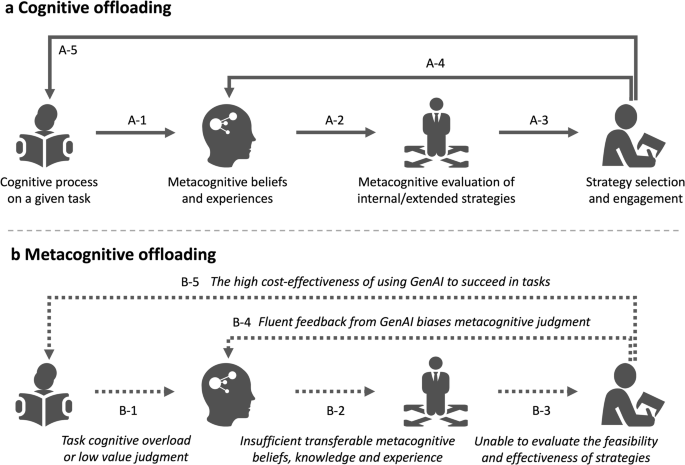
TL;DR: While generative AI can rapidly elevate task performance, excessive cognitive offloading threatens to erode the foundational problem-solving skills required for long-term competence.
Across software engineering, customer support, and technical education, generative artificial intelligence has established a clear track record of raising speed and output quality. Workers draft complex code in minutes, students receive real-time explanations, and operators synthesize sprawling system logs with single-sentence prompts. Yet this sudden elevation in immediate productivity masks a deeper operational issue. When artificial intelligence provides fluid, well-structured answers on demand, it frequently removes the struggle necessary for durable human comprehension.
The tension between executing a task quickly and understanding it deeply is now attracting rigorous study. A growing body of cognitive science demonstrates that output and comprehension are drifting apart. A technician or engineer can deliver a correct result by relying entirely on automated suggestions without building any internal mental model of why the solution worked. Over time, this dynamic creates an illusion of mastery that leaves organizations exposed whenever systems produce subtle errors, hallucinate data, or fail outright.
The Decoupling of Output and Understanding
Historically, acquiring workplace competency required progressive struggle. An apprentice or junior specialist learned by forming hypotheses, testing them against reality, diagnosing failures, and revising their approach. This feedback loop is fundamentally metacognitive, requiring individuals to monitor their own understanding, evaluate gaps in their reasoning, and adapt their strategies.
Generative AI short-circuits this mechanism. By generating polished, context-aware answers instantaneously, modern language models take over the generative and diagnostic burden. When an individual uses AI to solve an ambiguous problem, the system often handles the planning, synthesis, and error correction simultaneously. The observable performance looks exemplary: the report is submitted, the code passes its unit tests, or the network configuration is generated without delay.
However, cognitive psychologists point out that performance during a task is not the same as learning from it. Immediate success can happen alongside zero retention. When the cognitive friction of problem-solving is eliminated, the human brain has little incentive to encode the underlying principles into long-term memory. The user becomes an editor of automated output rather than an autonomous problem solver, leaving them ill-equipped when edge cases arise outside the model's training distribution.
The Dynamics of Metacognitive Offloading
To diagnose this shift, researchers focus on metacognition: the human capacity to monitor, regulate, and direct one's own cognitive processes. In any complex technical discipline, high-level competence relies heavily on metacognitive monitoring. An experienced professional constantly asks internal questions: Does this telemetry make sense? What underlying condition would explain this discrepancy? What are the edge cases of this proposed fix?
Metacognitive offloading occurs when an operator delegates these self-regulatory tasks to an external tool. Offloading is not inherently destructive; humans have long used written checklists, calculators, and reference manuals to free up working memory for higher-level reasoning. The difference with generative AI lies in the scope and depth of what is delegated.
Traditional tools offload storage or arithmetic, leaving diagnostic logic to the human. Modern artificial intelligence offloads the diagnostic logic itself. When users prompt an AI assistant to explain an anomaly and accept the provided narrative without independent verification, they surrender their active monitoring role. Over repeated interactions, users drift into automation complacency. They stop forming their own explanatory hypotheses and instead adopt a passive, receptive posture, trusting that the automated assistant will flag any inconsistencies.
Introducing the SYNC Framework
Addressing this vulnerability requires a structured way to balance automated execution with active human cognition. A perspective recently published in Nature outlines the Synergetic Notion of Human-AI Skills and Knowledge Construction, known as the SYNC model. The framework seeks to explain how humans can interact with advanced AI systems without surrendering their independent capability.
The SYNC framework formalizes the distinction between metacognitive offloading and what it terms metacognitive onloading. Offloading reduces cognitive effort by letting machines handle task execution, while onloading intentionally reintroduces specific forms of mental effort. Instead of treating AI as an automatic solution generator, an onloading approach uses the system to stimulate the user's critical evaluation, hypothesis generation, and verification routines.
Under this model, productive human-AI synergy exists only when both performance and learning remain intact. If offloading dominates, the human drifts into passive overreliance, generating high performance in routine scenarios but suffering severe skill degradation over time. Conversely, when users employ metacognitive onloading, they use the AI output as an object of scrutiny. They check assumptions, interrogate edge cases, and compare multiple machine-generated options against first principles. In doing so, the human maintains the deep processing required to cultivate durable expertise.
Turning Assistants from Crutches into Coaches
Translating the concept of metacognitive onloading into everyday workflows requires deliberate design choices in how technical tools operate. Most current enterprise AI interfaces are designed around maximum convenience: they prioritize fast, definitive answers. While this serves short-term throughput, it encourages intellectual passivity.
To preserve workforce competence, software environments must incorporate productive friction. Rather than delivering a finished configuration or diagnosis immediately, an AI assistant can be configured to act as a scaffold. In training and operational settings, the system can prompt the user to formulate their own diagnosis before revealing its findings. It can challenge the operator with counter-questions, highlight contradictory telemetry, or deliberately ask the user to verify specific assumptions against source documentation.
This approach mirrors the classic educational concept of the zone of proximal development, where assistance supports a learner without executing the work on their behalf. When an AI tool acts as an active sparring partner rather than an automated clerk, it forces the user to remain in an analytical state. The technician retains responsibility for reasoning, synthesis, and final judgment, using the model to stress-test their thinking rather than bypass it.
Why it matters
This cognitive balance is especially critical for physical infrastructure, telecommunications, and data centre operations, where the consequences of misplaced confidence are severe. In field environments, technicians increasingly rely on AI-assisted diagnostics and augmented reality overlays to troubleshoot fibre lines, power distribution units, and server racks. If these tools simply feed pre-packaged instructions to technicians, field teams can easily lose their intuitive grasp of hardware architecture, network protocols, and systemic root causes.
When standard telemetry is intact, an automated guidance system can make a novice perform like a seasoned engineer. But real-world infrastructure regularly faces novel failures, sensor malfunctions, and complex cascading outages that lie outside standard model parameters. If on-site technicians have offloaded their diagnostic instincts to an algorithm, their ability to conduct manual triage collapses precisely when it is needed most. Industrial operators must design their AI-assisted tools to reinforce, rather than replace, the mechanical and diagnostic reasoning of their workforce.
More from Trends
RSS
The Agentic Shift: How Autonomous Software Is Taking Over Enterprise Workflows
Enterprise IT is moving beyond generative chatbots toward autonomous agents that reason, plan, and execute actions, fundamentally reshaping corporate software stacks.

How Agentic AI Is Reshaping the Modern Executive Suite
CEOs are turning to autonomous AI agents to manage corporate knowledge, cut meetings, and critique strategy, fundamentally altering executive workflow.

Closing the Observability Gap as AI Agents Move Into Production
Autonomous software agents are executing real-world tasks without reliable telemetry, leaving enterprises blind to policy breaches and unauthorized system modifications.