A Multimodal Medical AI Connects Broad Diagnosis to Pixel-Level Reasoning
Researchers have developed EVLF-FM, a medical vision-language model trained on 1.3 million images that pairs diagnostic accuracy with pixel-level visual grounding.
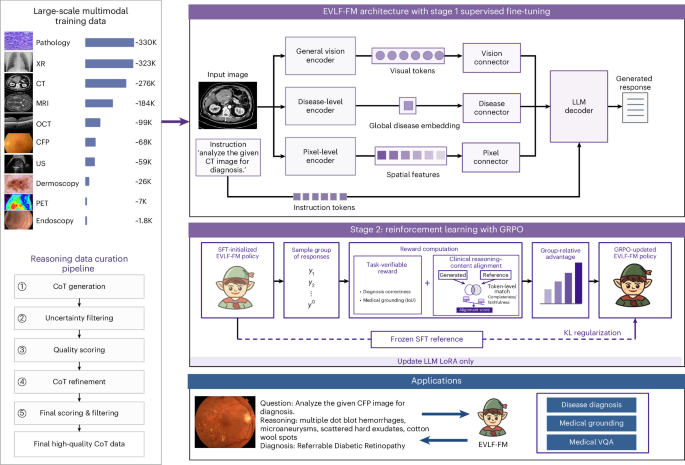
A new multimodal medical foundation model bridges broad diagnostic capabilities and fine-grained visual explainability, pinpointing exact image regions while justifying its clinical reasoning.
The Black-Box Dilemma in Medical Foundation Models
Artificial intelligence in healthcare has long struggled with a fundamental tension between scope and specificity. Early deep learning systems in medicine were rigidly narrow, trained on clean, hand-curated datasets to classify specific anomalies on single modalities, such as spotting diabetic retinopathy on retinal scans or detecting nodules on chest radiographs. While effective within their narrow boundaries, these specialized classifiers could not generalize across hospital departments or adapt to atypical presentations.
Over the past several years, the rise of foundation models promised to resolve this fragmentation. By pretraining large vision and language architectures on vast collections of unlabelled and semi-structured clinical data, researchers created generalist models capable of processing conversational queries, assessing diverse symptoms, and classifying multiple pathologies simultaneously.
Yet these generalist models introduced a different operational compromise. While broad multimodal architectures handle conversational tasks and high-level image classification with relative ease, they frequently stumble on spatial localization. In clinical practice, a physician rarely accepts an isolated probabilistic verdict. A diagnosis must be substantiated by precise visual evidence, such as the exact borders of an infiltrating lesion, subtle changes in vascular tissue, or minute cellular aberrations on a biopsy slide. Most large vision-language models act as opaque engines, generating plausible clinical prose without proving that their textual answers actually correspond to the specific pixels containing the pathology. This disconnect between global reasoning and local precision has remained one of the steepest barriers to clinical deployment.
Unifying Ten Modalities Under One Architecture
To bridge this divide, an international research team developed the Explainable Vision Language Foundation Model for Medicine, or EVLF-FM. Designed from the ground up to unite broad reasoning with fine-grained localization, the system processes tasks across ten distinct medical imaging modalities spanning six major clinical specialties: radiology, pulmonology, pathology, dermatology, ophthalmology, and hepatology.
The training corpus assembled for EVLF-FM represents one of the most comprehensive vision-language collections compiled for medical research. It encompasses more than 1.3 million clinical samples drawn from 18 global datasets. The images cover diverse diagnostic technologies, including computed tomography, magnetic resonance imaging, conventional X-rays, ultrasound, positron emission tomography, optical coherence tomography, dermatoscopy, color fundus photography, histopathology, and endoscopy.
Building a single architecture capable of interpreting both macroscopic structural scans like whole-body PET-CT and microscopic cross-sections of cellular tissue requires unusual representational flexibility. EVLF-FM tackles this using a two-tier training methodology that combines standard supervised fine-tuning with visual reinforcement fine-tuning.
In standard multimodal setups, vision encoders compress an image into abstract embeddings that feed directly into a language model. This process often strips away fine spatial coordinates. EVLF-FM explicitly preserves spatial awareness through visual grounding tokens. The reinforcement learning phase rewards the system not only for returning the correct diagnostic term, but also for identifying the bounding coordinates of the corresponding anomaly on the image grid. By optimizing both parameters in tandem, the model ensures that its internal attention mechanisms correspond directly to the physical signs of disease.
Benchmark Performance Across Diagnosis and Localization
To test whether EVLF-FM could match or exceed dedicated clinical baselines, the researchers subjected the architecture to rigorous internal and external validation pipelines focused on three primary tasks: disease classification, medical visual question answering, and pixel-level visual grounding.
In internal diagnostic benchmarks, EVLF-FM recorded an average diagnostic accuracy of 0.895 across clinical disciplines, outpacing both leading general-purpose vision-language models and specialized, single-domain baseline systems. Its performance was particularly steady when moving between vastly different imaging techniques, maintaining reliable classification whether reading subtle lung consolidations on planar X-rays or identifying pigment networks in suspicious skin lesions.
In visual grounding tests, which evaluate how accurately an algorithm draws boundaries around relevant anatomy based on a textual query, the model achieved an average accuracy of 0.842 across nine modalities at an intersection over union threshold of 0.5. This metric measures the degree of overlap between the algorithm's predicted region and human expert annotations. Achieving high overlap scores across disparate modalities indicates that the model is genuinely reading visual evidence rather than relying on language priors to infer what an anomaly ought to look like.
The research team subsequently verified these capabilities using an external validation cohort consisting of 13,443 independent samples compiled from 17 separate global datasets. Even when deployed in zero-shot and few-shot environments on patient populations the model had never encountered during training, EVLF-FM maintained competitive F1 scores. Notably, it did so while maintaining a smaller overall parameter footprint than several sprawling generalist models, demonstrating that targeted multimodal alignment can offset raw parameter count.
Verifying Clinical Reasoning with the S.C.O.R.E. Framework
A central innovation of EVLF-FM is its ability to provide readable, structured justifications alongside its bounding coordinates. When presented with a complex scan, the model produces a natural-language report outlining the visual indicators it observed, links those descriptions to tagged pixel regions, and articulates its clinical deduction.
However, in automated medical analysis, natural-language explanations can occasionally present an illusion of competence. Models sometimes hallucinate cogent, textbook-style rationales for incorrect diagnoses, or provide correct answers derived from irrelevant background artifacts. To assess whether EVLF-FM's explanatory text was genuinely faithful to the visual data, the researchers implemented a human evaluation protocol using the S.C.O.R.E. framework.
Under this evaluation system, practicing clinicians reviewed the model's generated justifications across five dimensions: structure, clarity, factual correctness, visual reference alignment, and clinical utility. Across an extensive battery of real-world patient cases, human reviewers awarded EVLF-FM an overall mean score of 4.25 out of 5. The clinicians noted that the model rarely relied on generic medical boilerplate, instead pointing directly to observable features such as tissue margins, density gradients, or pigment distributions that matched its textual narrative.
As reported in a research paper published in Nature, this alignment between visual grounding and language generation marks a substantial step toward auditable, generalist clinical artificial intelligence. Rather than forcing clinicians to scrutinize ambiguous heatmaps or saliency layers, which often highlight broad swaths of healthy tissue, the system offers an articulated rationale paired with clear spatial markers.
Practical Constraints and the Road to Deployment
Despite the model's strong benchmark scores, the authors emphasize that substantial clinical validation remains necessary before EVLF-FM can be integrated into live diagnostic workflows.
Retrospective dataset analysis, no matter how globally sourced, cannot replicate the chaotic conditions of live clinical intake. Scans in emergency departments are frequently degraded by motion artifacts, suboptimal exposure, anatomical hardware, and variations across imaging hardware vendors. Furthermore, the explanations generated by EVLF-FM are post hoc, derived by the model after its internal reasoning steps have occurred. While the grounding mechanisms enforce tight correspondence, there remains a theoretical risk that complex edge cases could yield plausible-sounding explanations that mask underlying algorithmic mistakes.
Before routine clinical use can be considered, the architecture must undergo prospective trials in active hospital networks. These studies will need to determine whether providing technicians and attending physicians with assistive, explainable models actually reduces diagnostic errors, shortens reporting times, or inadvertently introduces automation bias where human operators defer too readily to machine guidance.
Why It Matters
While EVLF-FM was engineered primarily for clinical diagnostics, its underlying technical blueprint holds direct implications for edge computing, field operations, and industrial inspection.
The success of EVLF-FM shows that multimodal models do not need to expand infinitely in parameter count to achieve high task precision. By implementing visual reinforcement fine-tuning that links textual reasoning to pixel coordinates, the researchers engineered a comparatively compact architecture capable of specialized spatial tasks. For data centre operators and telecommunications providers managing distributed edge infrastructure, this design proves that smaller, localized models can handle rigorous visual verification without constantly routing massive token streams back to centralized cloud clusters.
The same mechanics that localize an ophthalmic lesion can easily translate to complex field work. A technician inspecting fiber distribution hubs, cell towers, or high-density server racks relies on visual grounding to diagnose thermal anomalies, loose connectors, or frayed cabling. A system that simply states a cabinet has a fault is of limited utility. A system that highlights the exact port, describes the physical defect, and references the maintenance manual provides immediate field value. As multimodal vision-language architectures move into practical operations, the fusion of verbal reasoning with pixel-level accountability will be the defining standard for trustworthy automation.
More from Trends
RSS
Enterprise AI Startup Serval Hits $3 Billion Valuation in Push to Replace Legacy IT Platforms
Serval has raised $150 million at a $3 billion valuation to displace legacy ITSM providers with autonomous AI agents that run enterprise workflows.

The Napster Moment for Enterprise Software
Frontier AI models are automating the reverse engineering of proprietary code, triggering a software crisis reminiscent of the music industry's peer-to-peer disruption.

Why Enterprise AI Stalls Without Context
Despite widespread adoption, fewer than one in five enterprises see transformative value from AI. Bridging the gap requires an architectural context layer.