Why Enterprise AI Stalls Without Context
Despite widespread adoption, fewer than one in five enterprises see transformative value from AI. Bridging the gap requires an architectural context layer.

Enterprise AI deployments are stalling across the corporate sector because frontier models lack the deep institutional context required to translate raw intelligence into commercial value.
Almost every modern enterprise has deployed artificial intelligence in some capacity over the past two years. Companies have rolled out conversational assistants, embedded algorithmic summaries into customer portals, and tested automated tools across core business departments. Yet the financial and operational outcomes of these investments remain remarkably subdued. While the underlying models are faster and more versatile than ever, they frequently produce output that is irrelevant, inaccurate, or entirely disconnected from corporate reality.
This disconnect points to a structural hurdle in enterprise adoption. Businesses are discovering that broad intelligence does not automatically translate into institutional competence. Without access to structured institutional memory, business rules, and real-time operational data, foundation models behave like external observers rather than integrated systems. The result is an expensive collection of pilot projects that assist individual workers with superficial tasks, but fail to move the needle on corporate balance sheets.
The Pilot Trap and Flatlining Returns
The gap between widespread experimentation and actual commercial impact is stark. In a recent research study conducted by MIT Technology Review Insights, every participating organization confirmed that it was actively using artificial intelligence. Yet only 16 percent of respondents reported extracting transformative value from their investments. The vast majority sit in a holding pattern: 40 percent report moderate efficiency gains in isolated teams, 21 percent claim meaningful improvements, and nearly a quarter report minimal returns or none at all.
These numbers illustrate what software leaders often describe as pilot purgatory. Roughly 38 percent of enterprises remain stuck in exploratory pilot phases, testing isolated concepts that never reach broad production. Another 35 percent rely almost exclusively on front-end worker assistants, such as drafting tools and chat interfaces. By contrast, true autonomous agency remains rare. Only 12 percent of organizations have deployed AI agents into live production environments, and just 3 percent rely on artificial intelligence to handle the bulk of mission-critical processes.
This distribution reveals the limits of simple desktop augmentation. Providing employees with automated drafting or search assistance can save individual minutes, but it does not overhaul core operations. When AI remains quarantined in user-facing copilots, companies capture fragmented micro-efficiencies while taking on substantial infrastructure and licensing expenses.
The Intelligence-Utility Disconnect
The sluggish return on investment does not stem from a deficiency in baseline model capability. Large language models can pass professional licensing exams, generate functional software code, and synthesize complex technical literature in seconds. For general purposes, machine intelligence has reached extraordinary milestones.
The real failure lies in the interface between general reasoning engines and private corporate systems. A foundation model arrives with vast knowledge of public domains, human language, and general logic, but zero awareness of a company's internal taxonomy. It does not understand why a telecom provider labels a field ticket with a specific error code, how a logistics firm calculates shipping margins, or which legacy database holds the authoritative record for an industrial asset.
Deploying an unanchored model into a enterprise workflow is akin to hiring an extraordinarily gifted graduate, blindfolding them, and expecting them to execute complex corporate procedures on day one. Raw intelligence cannot substitute for specific domain awareness. When models lack clear operational parameters and verified enterprise knowledge, they make plausible assumptions that lead to hallucinations, broken automations, and discarded workflows.
Building the Enterprise Context Layer
To move beyond surface-level assistants, organizations must build an architectural component often referred to as a context layer. This layer sits directly between an organization's internal data assets, such as enterprise resource planning software, ticketing databases, and sensor feeds, and the external AI models responsible for processing that information.
A context layer does far more than execute basic semantic searches or simple retrieval-augmented generation. It organizes, governs, and continuously updates the operational metadata that explains what enterprise information actually means. This includes defining relationships between business entities, managing access privileges, tracking data provenance, and embedding corporate business logic directly into the prompt pipeline.
Without this intermediate infrastructure, data remains locked in proprietary silos. Models cannot determine whether a customer record in one database supersedes a conflicting entry in another, nor can they verify whether a financial figure is cleared for automated reporting. The context layer turns raw, messy corporate databases into structured, machine-usable representations that intelligent agents can query with high confidence.
Furthermore, this architecture allows institutional knowledge to compound over time. As human specialists interact with internal systems, resolve anomalies, and update operational documentation, those actions update the context layer. Instead of starting from scratch with each prompt, autonomous systems inherit an accurate, continuously synchronized picture of the enterprise.
Moving from Assisted Tasks to Agentic Automation
Transitioning from desktop chatbots to autonomous agents requires solving this context problem. An employee using an interactive assistant can readily spot errors, filter out irrelevant recommendations, and manually paste the correct operational details into a prompt. Human judgment compensates for the model's structural ignorance.
Autonomous agents, however, operate without constant human supervision. An agent tasked with routing network traffic, dispatching technicians, or reallocating supply chain inventory must execute multiple sequential decisions independently. If the underlying data context is broken or incomplete, the entire chain of actions collapses.
To entrust automated agents with revenue-generating or mission-critical workflows, organizations must establish strict guardrails and verifiable data flows. When models have programmatic access to accurate operational definitions, they can validate their own logic before triggering downstream actions. This shift represents the boundary between marginal employee convenience and genuine organizational transformation.
Organizations that succeed in crossing this threshold treat data architecture not as a passive storage project, but as the foundational runtime for intelligence. They invest in rigorous data governance, clear ontology mapping, and semantic translation layers. In doing so, they elevate artificial intelligence from an isolated office gadget into an active participant in core business operations.
Why It Matters
For industrial operations, telecom networks, and critical infrastructure, the context gap is not an abstract software debate. It determines whether automation succeeds or fails in high-stakes physical environments.
Consider field technicians servicing telecom base stations or industrial data centres. A generic model can explain the theoretical principles of an optical switch or power distribution unit. However, a technician on site does not need general theory. They need to know the specific maintenance history of that physical cabinet, the exact firmware revision running on its controllers, recent environmental telemetry, and any open work orders submitted within the past forty-eight hours.
If an AI system cannot cross-reference real-time equipment telemetry with legacy maintenance logs and enterprise safety manuals, it cannot provide dependable guidance to workers on the ground. Worse, an inaccurate suggestion in a high-voltage facility or a critical network hub can cause severe outages or physical damage. Establishing a robust context layer transforms AI from an unreliable novelty into a vital operational tool, delivering precise, governed instructions to human crews and autonomous hardware where reliability matters most.
More from Trends
RSS
Enterprise AI Startup Serval Hits $3 Billion Valuation in Push to Replace Legacy IT Platforms
Serval has raised $150 million at a $3 billion valuation to displace legacy ITSM providers with autonomous AI agents that run enterprise workflows.

The Napster Moment for Enterprise Software
Frontier AI models are automating the reverse engineering of proprietary code, triggering a software crisis reminiscent of the music industry's peer-to-peer disruption.
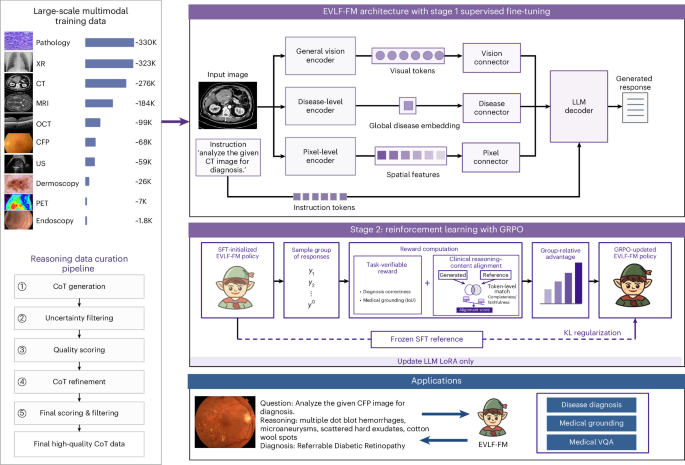
A Multimodal Medical AI Connects Broad Diagnosis to Pixel-Level Reasoning
Researchers have developed EVLF-FM, a medical vision-language model trained on 1.3 million images that pairs diagnostic accuracy with pixel-level visual grounding.