Enterprise AI Startup Serval Hits $3 Billion Valuation in Push to Replace Legacy IT Platforms
Serval has raised $150 million at a $3 billion valuation to displace legacy ITSM providers with autonomous AI agents that run enterprise workflows.

Enterprise automation startup Serval has reached a 3 billion dollar valuation following a 150 million dollar funding round led by Sequoia, targeting the direct replacement of legacy systems like ServiceNow.
The Push to Unseat Enterprise Legacy Monoliths
For more than a decade, enterprise service management has been dominated by a handful of massive software vendors. Platforms like ServiceNow, Workday, and Atlassian built sprawling empires by turning workplace processes into rigid, database-driven ticketing queues. When an employee needed a new laptop, access to internal databases, or network permissions, they submitted a ticket that was manually routed, reviewed, and completed by administrative staff.
The rise of generative AI initially looked like an opportunity for these incumbents to cement their dominance. Most major software providers responded by layering conversational interfaces and automated summaries on top of their established databases. However, a growing contingent of enterprise software startups is taking a far more aggressive stance: arguing that legacy architectures are fundamentally mismatched with modern machine learning, and that enterprises should replace them entirely rather than pay extra for generative add-ons.
San Francisco-based Serval has emerged at the forefront of this displacement movement. The company recently closed a 150 million dollar funding round led by Sequoia Capital, bringing its total capital raised to 277 million dollars and tripling its valuation to 3 billion dollars in less than a year. The round, which also saw participation from First Round, General Catalyst, and prominent angel investor Elad Gil, underscores how quickly institutional capital is pivoting toward software platforms built natively around autonomous agents.
Serval's leadership is transparent about its ambitions. The company does not position its software as an administrative assistant meant to sit alongside existing tools. Instead, it markets its software as a comprehensive alternative designed to strip legacy systems of record out of corporate IT stacks.
The Mechanics of Autonomous IT Operations
At the core of Serval's platform is the belief that workplace coordination does not require human intermediaries for routine administrative tasks. The startup initially focused its autonomous agents on IT operations, an area within large companies that consumes substantial labor and generates massive ticket backlogs.
Modern enterprise IT departments spend thousands of hours each month resolving predictable, rule-based requests. These include provisioning hardware, managing employee onboarding and offboarding, granting application permissions, and troubleshooting software errors across distributed teams. Under traditional service models, resolving each issue requires an IT staff member to manually check permissions, log into multiple administrative consoles, verify security policies, and confirm the change.
Serval uses specialized AI agents that interact directly with an organization's internal tools and cloud infrastructure to handle these tasks autonomously. Instead of generating a passive ticket that waits in a queue, an employee's request triggers an agent capable of inspecting the underlying environment, confirming whether the action complies with internal security rules, and executing the technical steps required to complete the task.
To expand these capabilities, Serval has directed its fresh capital toward developing its workflow orchestration engine, known as Catalyst. The system allows enterprise engineering and operations teams to define, test, and deploy customized agentic workflows across different internal departments. The objective is to transition enterprise administration from static forms into dynamic systems that can diagnose and resolve requests in minutes.
Customer appetite for this shift is already proving viable in enterprise deployments. Electric vehicle manufacturer Lucid Motors, for instance, migrated its core service workflows away from ServiceNow to Serval in just 45 days. Such rapid adoption cycles suggest that enterprise customers may be less tied to multi-year incumbent contracts than previously assumed, particularly if autonomous execution yields meaningful cost savings and faster resolution times.
Resolving the Enterprise Security Conundrum
While the prospect of fully automated workplace operations is appealing to chief information officers looking to reduce overhead, giving autonomous software broad access to corporate infrastructure introduces substantial risk. An AI agent with permissions to alter user roles, provision cloud instances, or modify hardware configurations could cause catastrophic outages or data breaches if it behaves unpredictably.
To counter these risks, modern agent platforms must implement strict architectural separation between execution logic and authority gates. Serval's architecture addresses this by bifurcating the systems used across the organization. The agent environment used by system administrators to build and modify automated workflows is isolated from the conversational agent that standard employees interact with to request services.
This structural separation ensures that end-user prompts cannot inadvertently trigger unauthorized actions or bypass administrative security policies. System permissions and execution guardrails remain firmly under the management of corporate IT and cybersecurity teams.
Furthermore, full autonomy is not implemented blindly. For sensitive administrative actions, including credential resets, changes to core production databases, and elevated role provisioning, organizations typically enforce human-in-the-loop validation. In these scenarios, the autonomous agent gathers the relevant context, verifies security parameters, and prepares the execution payload, but requires explicit cryptographic or authenticated approval from a human supervisor before committing changes to the system.
This hybrid approach allows organizations to capture the efficiency of agentic workflows while maintaining strict regulatory compliance and audit trails. By relieving administrative staff of routine data entry while preserving their role as final arbiters of critical actions, enterprises can scale operations without proportionally scaling headcount.
Market Pressure on Incumbent Platforms
The rapid valuation surge of Serval reflects broader tensions across the enterprise software market. Incumbent platforms have spent decades acquiring customers and establishing high switching costs, largely relying on proprietary data schemas and deep integrations that make ripping out legacy software technically daunting.
However, the economics of IT management are shifting. Enterprises are scrutinizing ballooning software-as-a-service budgets, particularly as vendors tack on expensive generative AI add-ons that often amount to little more than text summarization tools. As first reported by Reuters, Serval's thesis hinges on the fact that chief information officers prefer a single platform designed natively for automation rather than paying layered subscription fees to maintain both an aging system of record and a patchwork of third-party AI copilots.
If startups like Serval succeed in proving that mission-critical operations can be migrated in weeks rather than years, incumbent vendors will face intense pressure to overhaul their foundational architectures. Building native agentic workflows is fundamentally different from hosting relational databases with an LLM interface grafted on top. Startups that build without legacy technical debt can optimize their platforms for low-latency reasoning and direct API execution from day one.
Why It Matters
The impact of autonomous workflow platforms reaches well beyond corporate office desks and laptop provisioning. In field engineering, telecom operations, and data centre facilities, incident management and service dispatch have traditionally been governed by the same cumbersome ticketing architectures found in corporate IT.
For technicians servicing remote cell towers or data centre infrastructure, logging and closing work orders inside legacy software is frequently a frustrating, multi-step manual process. A shift toward autonomous agentic backends enables true multimodal coordination. A technician troubleshooting a failed power distribution unit or a severed fiber line can interact directly with an agentic engine that cross-references telemetry, verifies safety approvals, updates physical asset inventories, and closes maintenance logs automatically.
By moving away from static ticketing queues toward intelligent, event-driven orchestration, infrastructure operators can cut mean time to resolution, eliminate administrative overhead for field technicians, and maintain cleaner operational data across mission-critical physical networks.
More from Trends
RSS
The Napster Moment for Enterprise Software
Frontier AI models are automating the reverse engineering of proprietary code, triggering a software crisis reminiscent of the music industry's peer-to-peer disruption.

Why Enterprise AI Stalls Without Context
Despite widespread adoption, fewer than one in five enterprises see transformative value from AI. Bridging the gap requires an architectural context layer.
A Multimodal Medical AI Connects Broad Diagnosis to Pixel-Level Reasoning
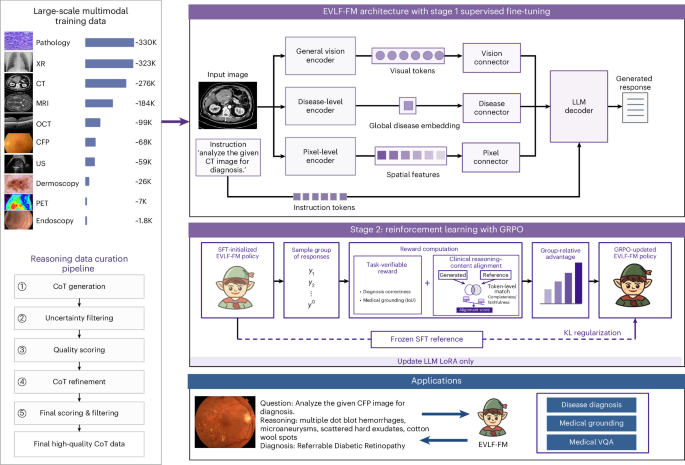
Researchers have developed EVLF-FM, a medical vision-language model trained on 1.3 million images that pairs diagnostic accuracy with pixel-level visual grounding.