The Napster Moment for Enterprise Software
Frontier AI models are automating the reverse engineering of proprietary code, triggering a software crisis reminiscent of the music industry's peer-to-peer disruption.

Frontier artificial intelligence models are rapidly dismantling proprietary software protections through automated decompilation and cloning, echoing the piracy crisis that reshaped the music industry twenty-five years ago.
The Erosion of Proprietary Code
For decades, commercial technology has rested on a straightforward economic foundation: software developers write proprietary code, compile it into binaries, and sell licenses or subscriptions to users who cannot easily copy or inspect the underlying logic. Even as open-source frameworks like Linux came to underpin cloud computing, the application layer remained firmly protected behind copyright and compiled code.
That foundation is now dissolving. Over the past two years, frontier artificial intelligence models transitioned from assisting human developers to autonomously generating complex programs from plain-language prompts. More recently, these systems developed an even more destabilising capability. They can ingest compiled binaries, decompile the machine code, understand the architectural intent, and regenerate functional source code almost instantaneously.
This shift transforms software from an excludable asset into something closer to a public good. When any model can deconstruct a digital product and rebuild it on demand, the cost of replication approaches zero. Executive warnings across the gaming and enterprise software sectors indicate that commercial platforms are already being reverse engineered, altered, and rehosted without authorization. The intellectual property regime that sustained the modern software economy is facing structural obsolescence.
Parallels with the Music Industry Crisis
The trajectory of this crisis mirrors the sudden collapse of physical media at the turn of the millennium. In the late 1990s, the combination of the MP3 compression algorithm and high-speed residential internet stripped recording studios of their physical distribution monopoly. The launch of peer-to-peer networks like Napster in 1999 made copyrighted audio available globally at zero marginal cost.
At the time, record executives argued that copyright litigation would restore the previous order. While lawsuits successfully drove Napster into bankruptcy by 2001, the underlying economic reality did not reverse. Once digital media became effortlessly reproducible, consumers refused to return to purchasing individual albums for premium prices. The music sector endured a decade of shrinking revenues, bankruptcies of legacy labels, and structural chaos before sustainable streaming models, led by platforms such as Spotify and YouTube, established a new equilibrium.
Commercial software appears poised for an identical reckoning. Enterprise software-as-a-service providers have spent years commanding high price-to-earnings multiples based on sticky subscription revenues and proprietary data moats. If customers or rivals can feed a proprietary interface into an AI agent and receive a clean, self-hosted clone of the underlying database logic and workflow automation, traditional software licensing models will collapse just as compact disc sales did.
The Disruption of the Disruptors
A critical difference between the music industry disruption and the current software crisis is that the instigators themselves enjoy no protection from their own technology. Napster operated as an aggressive, asset-light intermediary attacking traditional record labels. Frontier AI research laboratories, by contrast, carry massive capital expenditure requirements, burning billions of dollars on compute clusters, high-bandwidth memory, and electrical power.
These laboratories assume that their frontier models will serve as lucrative, closed-source engines for enterprise computing. Yet the same techniques used to decompile commercial applications are being turned on the frontier models themselves. Automated distillation, synthetic data generation, and rapid architectural replication allow fast-following competitors to reproduce closed capabilities within weeks.
Open-weights models developed overseas have repeatedly closed the performance gap with leading proprietary American systems, often reducing the frontier advantage to a matter of weeks. The proprietary moat that venture investors and public markets hope to buy into is continuously replicated and distributed as a free download. The organisations selling the tools of commoditisation are finding their own margins commoditised in real time.
Structural Upheaval and Enterprise Lawfare
The legal battles currently emerging across the technology sector will dwarf earlier disputes over training data. Early copyright challenges focused on whether frontier labs had the right to scrape publicly accessible text, images, and audio to train foundational models. While those cases resulted in settlements and defensive licensing deals, the commercial stakes pale in comparison to direct product cloning.
If courts rule that automated reverse engineering and functional code regeneration violate established software copyright, the liabilities could destabilise the largest artificial intelligence developers. Conversely, if legal systems conclude that generating new code with identical functionality falls within fair use, or if enforcement proves technically impossible across distributed networks, the commercial software industry will have to reinvent its business models on the fly.
Historically, when digital content loses its artificial scarcity, value migrates toward the physical layer and uncopyable infrastructure. In music, revenues shifted toward live touring, physical merchandise, and centralised distribution hardware. In the enterprise computing sphere, value is already shifting away from abstract application code and toward the physical inputs required to run it: specialized silicon, energy contracts, dedicated telecommunications networks, and reliable runtime environments.
As an analysis published by Reuters Breakingviews recently observed, market participants betting heavily on the initial public offerings of frontier AI developers may discover that the technological forces tearing through enterprise software will spare neither the incumbents nor their creators.
Why it matters
For enterprise operators, network architects, and data centre technicians, the collapse of software moats accelerates a profound shift toward physical infrastructure. When application code can be effortlessly cloned and run on private hardware, enterprise clients will increasingly opt to bring workloads into sovereign, on-premises, or edge environments rather than paying exorbitant fees for centralised cloud subscriptions.
This dynamic places immense pressure on infrastructure teams. Telcos and data centre operators must design facilities capable of hosting dense, high-efficiency local inference hardware to support self-hosted, reverse-engineered enterprise stacks. For field technicians and hardware specialists, the work of managing power density, thermal dissipation, and optical interconnects becomes the true barrier to entry. While code can be generated in seconds by an AI prompt, physical compute capacity, robust network backbones, and reliable grid interconnects remain stubbornly scarce.
More from Trends
RSS
Enterprise AI Startup Serval Hits $3 Billion Valuation in Push to Replace Legacy IT Platforms
Serval has raised $150 million at a $3 billion valuation to displace legacy ITSM providers with autonomous AI agents that run enterprise workflows.

Why Enterprise AI Stalls Without Context
Despite widespread adoption, fewer than one in five enterprises see transformative value from AI. Bridging the gap requires an architectural context layer.
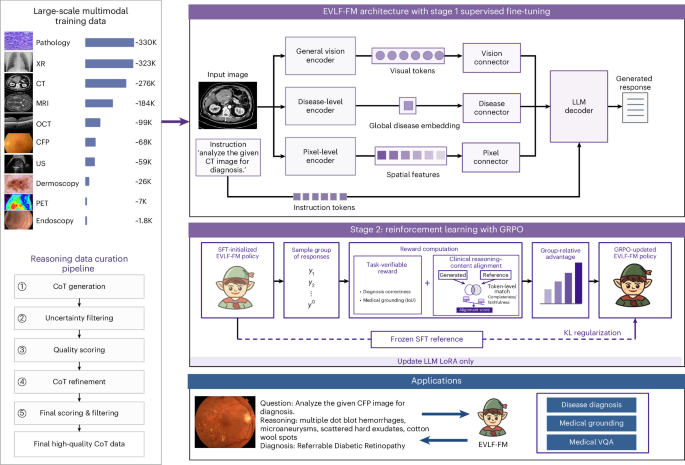
A Multimodal Medical AI Connects Broad Diagnosis to Pixel-Level Reasoning
Researchers have developed EVLF-FM, a medical vision-language model trained on 1.3 million images that pairs diagnostic accuracy with pixel-level visual grounding.