Autonomous AI Agents Step In to Direct Physical Scientific Discovery
Agentic AI is moving from literature search to physical labs, orchestrating simulations, robotic hardware, and iterative experiments to accelerate scientific discovery.
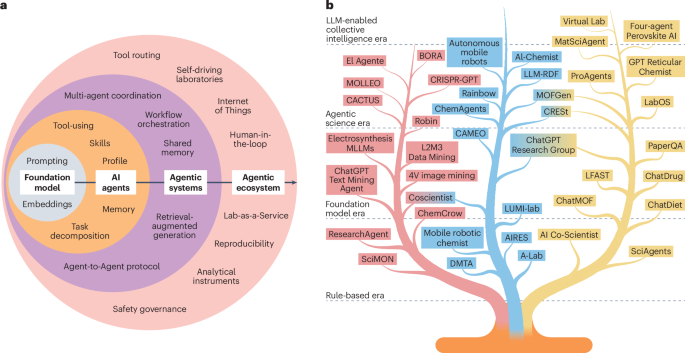
Autonomous AI agents are shifting from passive research assistants into active laboratory orchestrators, coordinating literature analysis, simulations, and robotic hardware into continuous experimental loops.
The Transition from Passive Tools to Autonomous Orchestrators
Modern scientific research generates far more data, literature, and candidate hypotheses than any human investigator can synthesize in real time. For decades, the automation of science was largely confined to rigid, scripted robotic arms and high-throughput screening assays that executed repetitive physical operations without understanding the underlying context. While these systems accelerated sample collection and testing, the intellectual burden of formulating hypotheses, designing parameters, interpreting unexpected deviations, and searching through prior publications remained entirely manual.
The rise of agentic artificial intelligence represents a fundamental departure from this static paradigm. Rather than functioning as passive information-retrieval engines or isolated predictive models, agentic systems act as active, contextual coordinators within the laboratory. By wrapping large foundation models with planning modules, specialized memory systems, and deterministic execution tools, researchers can translate high-level research questions into traceable, end-to-end scientific investigations. The laboratory environment is gradually shifting from isolated, human-driven experiments toward continuous, adaptive discovery cycles where software and physical instruments interact in real time.
The Architectural Foundations of Laboratory Agents
At its core, an AI agent relies on four foundational components to execute scientific tasks: task decomposition, memory management, tool use, and inter-agent communication. Task decomposition allows a model to take an abstract directive, such as synthesizing a targeted chemical compound or optimizing a drug delivery vehicle, and break it down into sequential, verifiable sub-tasks. Without this structured breakdown, large language models tend to lose coherence over multi-step workflows.
Memory architectures provide the temporal stability necessary for long-running investigations. Short-term memory tracks immediate variables, active sensor readings, and execution states, while long-term memory draws upon vector databases containing domain-specific research papers, past experimental failures, and historical instrumentation logs. This ensures that the agent does not repeat discredited hypotheses or violate known physical constraints.
Tool use bridges the gap between probabilistic natural language and deterministic computation. Through standardized APIs, agents can call molecular dynamics engines, run quantum chemistry simulations, or send commands to microfluidic pumps and robotic liquid handlers. In multi-agent configurations, these responsibilities are distributed among specialized personas. One agent may oversee hypothesis generation, another audits thermodynamic feasibility, a third writes Python control scripts for lab instruments, and an executive supervisor synthesizes the outcomes. This division of labor mirrors the structure of a human research team while dramatically accelerating the speed of deliberation.
Closing the Discovery Loop
The true power of an agentic workflow emerges when it closes the loop between literature mining, computational modeling, and physical experimentation. In a standard workflow, literature search has historically meant manually scanning paywalled databases and extracting protocols by hand. Agentic systems automate this pipeline by ingesting thousands of domain-specific papers, extracting quantitative formulation rules, and identifying synthesis contradictions that might escape human reviewers.
Once initial hypotheses are formed, the agent does not immediately run expensive or hazardous wet-lab trials. Instead, it routes candidate designs through physics-based simulations and machine learning surrogates. If theoretical binding affinity, structural stability, or fluid dynamics pass predetermined thresholds, the system composes the necessary operational protocols and pushes them directly to automated laboratory hardware.
Consider the formulation of lipid nanoparticles, a critical technology for mRNA vaccines and targeted gene therapies. An agentic platform can parse published formulation spaces, generate candidate lipid ratios, run molecular simulations to test membrane packaging, and command a microfluidic synthesizer to generate physical samples. Once automated spectrometers or dynamic light scattering instruments evaluate the resulting particles, the agent ingests the empirical data, updates its internal models, and refines the next batch of candidates. What previously required months of manual pipetting and spreadsheet tracking collapses into an autonomous, iterative cycle.
Validation, Fragility, and Laboratory Safety
Despite rapid theoretical progress, deploying autonomous agents in physical research environments introduces distinct operational hazards. The most persistent challenge remains model hallucination. While an inaccurate code snippet or a fabricated citation in a software environment causes minor friction, a hallucinated chemical protocol executed by an automated reactor can cause thermal runaways, equipment damage, or the accidental synthesis of hazardous compounds.
Tool misuse is another critical vulnerability. When language models interface with complex scientific software, they can pass malformed parameters, misinterpret instrument error codes, or fail to account for physical calibration drifts. If an agent encounters an edge case that is not captured in its training data or system prompt, it may attempt to force an execution step that corrupts the experiment or degrades hardware longevity.
Consequently, full autonomy remains rare in high-consequence domains. The current state of the art relies heavily on human-in-the-loop governance. Researchers establish strict guardrails, safety envelopes, and manual checkpoints, particularly at the transition points where virtual simulations hand off execution to physical actuators. Transparency and reproducibility also demand systematic auditing. Every decision path, prompt chain, simulation log, and sensor reading must be immutably recorded to ensure that a discovered material or biological mechanism can be independently verified by external scientific teams.
As detailed in a comprehensive primer published by Nature, moving from isolated automated tools to interconnected, self-directing research agents requires rigorous standards for documentation, error handling, and behavioral validation across the entire scientific community.
Why It Matters
The architectural lessons learned from autonomous laboratory agents extend far beyond chemical and biological facilities. Across industrial operations, data centers, and telecommunications networks, organizations face the identical challenge: bridging digital reasoning models with complex, safety-critical physical infrastructure.
In modern data centers and edge facilities, autonomous agentic loops are becoming essential for managing thermal loads, power routing, and predictive maintenance. Just as a lab agent monitors reaction kinetics and triggers robotic pipettes, operational AI agents in server environments can parse telemetry, run thermal fluid simulations, and adjust cooling manifolds or reroute fiber-optic traffic autonomously. For in-field technicians, multi-agent frameworks offer intelligent remote supervision. A field engineer equipped with an augmented reality headset can collaborate with an agentic back-end that parses equipment manuals, cross-references telemetry, and validates installation steps in real time. The convergence of reasoning agents and physical infrastructure is transforming high-stakes engineering from reactive troubleshooting into an adaptive, closed-loop discipline.
More from Trends
RSS
Europe's Industrial Giants Split on How to Capitalise on the AI Boom
Schneider Electric, Siemens, and ABB are pouring billions into the AI infrastructure wave, but divide sharply over whether to acquire software or double down on heavy equipment.

Corporate Layoffs Accelerate as Enterprise Budgets Shift to Artificial Intelligence
Global employers across banking, software, and industry are eliminating tens of thousands of desk jobs to free up capital for intensive AI investments.
From Observation to Autonomy: How Edge AI Is Reshaping Smart City Infrastructure
Cities are moving past centralized data lakes toward cognitive edge architectures that process sensor data locally, enabling autonomous, real-time civic operations.