LeakAgent: AI-Driven System Revolutionizes Water Leak Detection
A groundbreaking multi-agent AI system, coordinated by a large language model, is transforming water leak detection by unifying previously siloed processes, achieving high accuracy across diverse networks.
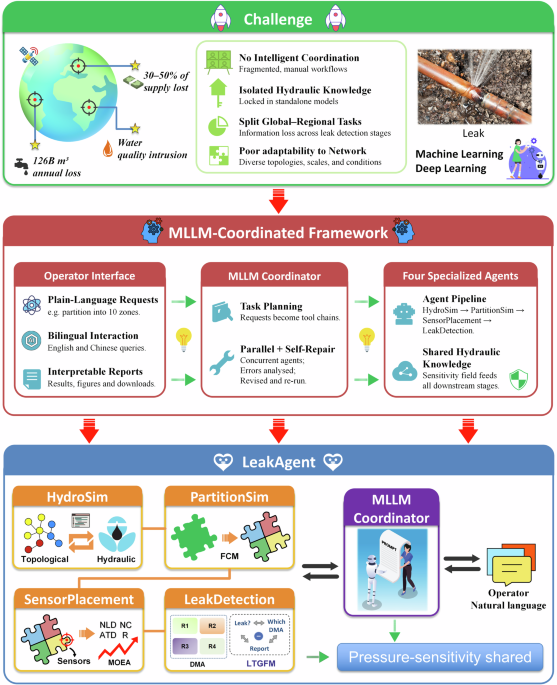
A new AI-driven multi-agent system, coordinated by a large language model, offers a unified and highly accurate approach to detecting leaks in water distribution networks, overcoming limitations of traditional and prior data-driven methods.
The Pervasive Problem of Water Loss
Water distribution networks represent critical infrastructure globally, ensuring that billions of people have access to potable water. The reliable operation of these systems is fundamental to public health, economic stability, and environmental sustainability. However, these complex networks are plagued by significant water losses due to leakage. Current estimates suggest that water utilities worldwide lose an astounding 126 billion cubic meters of water annually. In many regions, this can account for 30% to 50% of the total water supply. The implications extend beyond financial cost; leaks compromise water quality, waste considerable energy in pumping and treatment, and exacerbate water scarcity issues, particularly in vulnerable areas.
The imperative for efficient leak detection and management is therefore immense. Traditional methods often involve manual inspections, which, while offering clarity on individual leaks, are inherently slow, expensive, and limited in their ability to adapt to dynamic network conditions or provide real-time insights. The sheer scale and complexity of modern water systems demand more sophisticated solutions.
Evolution of Data-Driven Detection
To address the shortcomings of manual inspections, the field has seen a significant shift towards data-driven approaches, leveraging advanced sensor networks and the Internet of Things (IoT). Early attempts in this domain were largely statistical, relying on threshold-based monitoring of metrics like pressure, flow rates, or water quality indicators. While an improvement, these methods often struggled with accuracy and adaptability across different network configurations or under varying operational conditions.
More recently, the application of machine learning (ML) and deep learning (DL) techniques has marked a substantial leap forward. Algorithms such as support vector machines, artificial neural networks, convolutional neural networks, and graph neural networks have demonstrated an ability to uncover intricate spatio-temporal relationships within the vast amounts of time-series data generated by water networks. These advanced models can process complex patterns to identify anomalies indicative of leaks.
Despite these advancements, existing methodologies typically treat leak detection as a multi-stage process. This often involves a 'global detection' phase to determine if an anomaly exists, followed by a 'regional detection' phase to pinpoint the affected sub-areas or District Metered Areas (DMAs). While researchers have introduced specialized physics-informed priors, such as pressure-leak duality, and deployed optimization routines for sensor placement, these approaches still often tackle individual pipeline stages in isolation. This fragmented approach limits their overall effectiveness, creating systems that can be technically challenging to implement, inefficient in resource utilization, and difficult to scale across diverse and complex utility networks.
Unifying Detection with Multi-Agent AI
A significant limitation of previous data-driven leak detection systems has been the lack of a coordinated workflow that integrates various crucial tasks such as hydraulic simulation, network partitioning, optimal sensor placement, and the actual leak detection process. These components have historically been treated as separate problems, leading to reduced accuracy and challenges in transferring solutions from one network to another without extensive manual recalibration.
However, a pioneering new system, dubbed LeakAgent, developed by researchers and detailed in Nature, proposes a radical shift. LeakAgent is a multi-agent system (MAS) that achieves unprecedented coordination through a large language model (LLM). This LLM acts as an orchestrator, facilitating natural language-based interaction and intelligent management across the various specialized AI agents within the system. The key innovation lies in its ability to unify disparate tasks under a single, cohesive framework.
At the core of LeakAgent's methodology is the calculation of a single hydraulic pressure-sensitivity field. This field, computed just once, provides foundational data that concurrently informs several critical operations: the optimal zoning of the network, the strategic placement of sensors, and the ultimate detection of leaks. This integrated approach replaces the need for separate, sequential analyses, significantly streamlining the process.
Furthermore, LeakAgent employs a dual-branch graph model. This model is designed to jointly determine both the presence of a leak and the specific network partition affected by it. This is a crucial improvement over systems that first detect a leak and then attempt to localize it. The LLM coordinator also possesses a unique self-correction capability, allowing it to autonomously detect and rectify its own execution faults, enhancing the system's robustness and reliability.
Performance and Practical Implications
The efficacy of LeakAgent was rigorously tested across five different water distribution networks, ranging in size from 191 to 920 nodes. The results were highly impressive: the system demonstrated approximately 96% accuracy in both detecting leaks and identifying the affected network partition, even for relatively small leak magnitudes of 20%. Critically, LeakAgent proved to be stable and reliable even when subjected to realistic levels of demand and sensor noise, conditions that often degrade the performance of less robust systems.
Perhaps one of the most significant breakthroughs is the system's transferability. LeakAgent was able to move between different networks without requiring manual retuning, a common and time-consuming bottleneck in deploying AI solutions for critical infrastructure. This plug-and-play capability drastically reduces the technical barriers and resource overhead typically associated with implementing such sophisticated systems across diverse utility operations. The research, published in Nature, marks a substantial advance in smart water network management.
Why it matters
For telecommunications, data center operations, and industrial facilities, the principles demonstrated by LeakAgent hold significant relevance. The ability of a large language model to coordinate specialized AI agents for real-time anomaly detection and localization in complex physical networks offers a blueprint for enhancing infrastructure resilience. In data centers, this could mean multi-modal sensor data (temperature, power draw, network traffic) being analyzed by an LLM-orchestrated system to identify potential overheating, power inefficiencies, or cyber threats in specific racks or server clusters. For telco networks, similar multi-agent systems could detect and pinpoint failures in optical fiber, base stations, or network nodes by correlating various data streams, leading to proactive maintenance and reduced downtime. This approach represents a paradigm shift towards truly intelligent, self-optimizing, and fault-tolerant infrastructure management, moving beyond siloed monitoring tools to an integrated, AI-driven command and control system.
More from Trends
RSS
Augmented Reality System Helps Autistic Children Decode Emotions
A novel augmented reality system, built on an upgraded Google Glass platform, is showing promising results in helping children with autism spectrum disorder recognize and interpret human emotions in real-time.
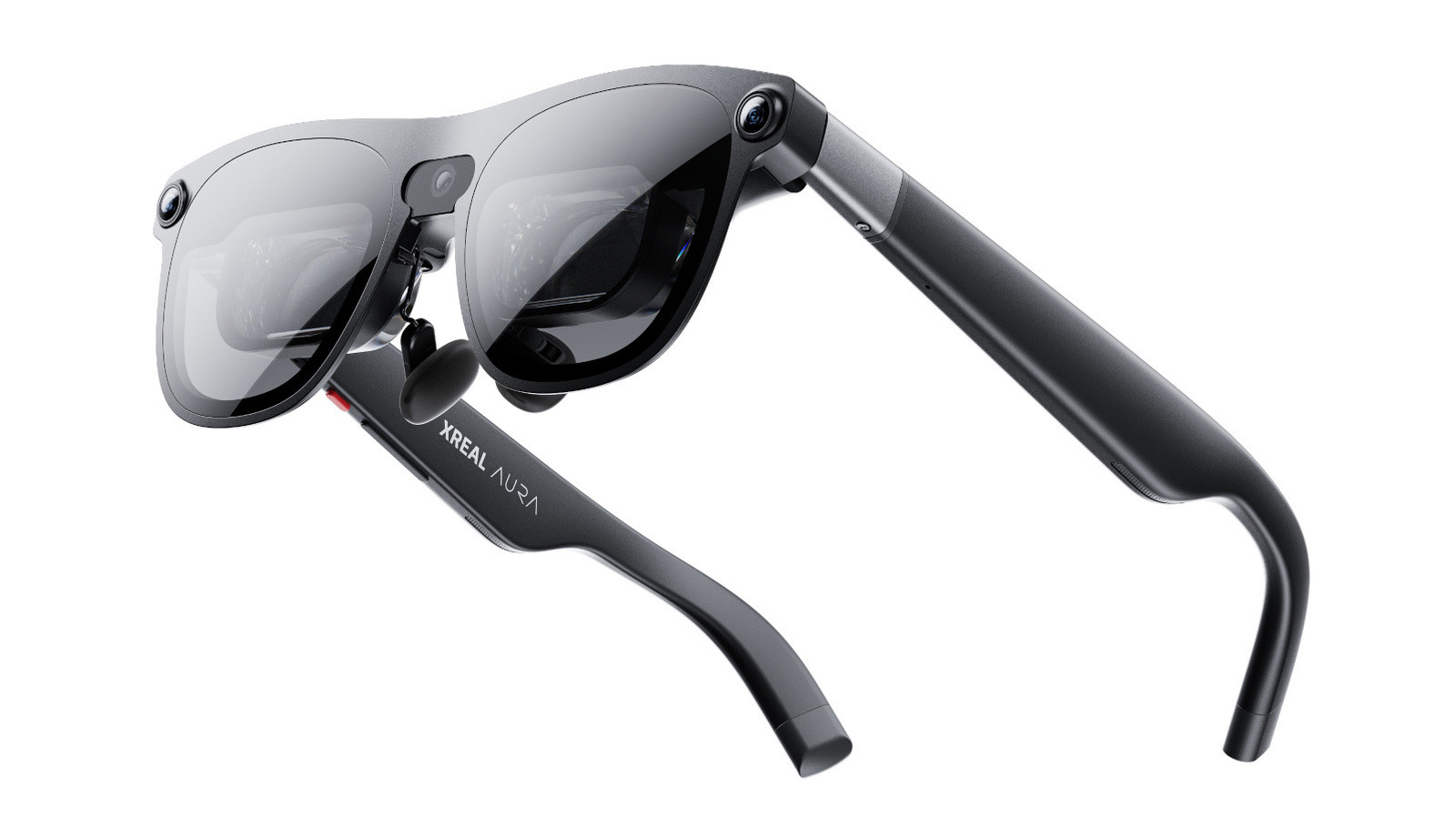
Xreal's Aura Smartglasses Offer a Glimpse into the Tethered AR Future
Xreal's Aura smartglasses, featuring Android XR and Snapdragon Reality Elite, are now available for pre-order, promising a high-fidelity augmented reality experience.

Schneider Electric's $22.6 Billion Acquisition of PTC Signals Major AI Software Push
Schneider Electric's largest-ever acquisition of US software firm PTC for $22.6 billion positions the company to dominate the industrial AI and data center software market.