Rethinking the Black Box: Inside the Debate Over Neural Network Legibility
A fresh look at neural network inner workings suggests large models may be far easier to decode, monitor, and audit than previously thought.

A prominent AI researcher argues that neural networks are far more orderly than long believed, suggesting that the black box dilemma stems from human analytical errors rather than impenetrable machine logic.
For nearly a decade, the field of artificial intelligence has operated under an uncomfortable assumption: the most powerful systems in the world are fundamentally impossible to understand. Machine learning models, particularly deep neural networks and large language models, are routinely compared to living organisms rather than engineered artifacts. Engineers train them on massive datasets, observe their outputs, and accept that the billions of mathematical weights inside form an impenetrable knot of statistical correlations. When systems misbehave, hallucinate, or take unexpected actions, engineers often lack the diagnostic tools to explain why.
That consensus was challenged when Nick Cammarata, a researcher at the interpretability startup Goodfire and formerly of OpenAI, published an exhaustive 26,000-word analysis. His central claim is deceptively simple: neural networks are not inherently tangled beyond recognition. Instead, researchers may simply have been looking at them with the wrong assumptions. If Cammarata is correct, decoding the internal circuitry of modern models might be significantly more achievable than current doctrine suggests, offering an unexpected path toward systematic auditing and control.
The Roots of the Tangled Knot
To understand why this claim has generated such intense debate, one has to examine mechanistic interpretability, the subdiscipline dedicated to cracking open AI systems. For years, the leading paradigm in the field held that neural networks rely heavily on a phenomenon known as superposition.
Superposition occurs when a single neuron inside a network responds to multiple, seemingly unrelated concepts. During early research on small vision architectures such as Inception v1, researchers discovered that individual neurons would activate in response to both cats and cars, or other entirely disconnected categories. The prevailing explanation was that the network had run out of dedicated parameters and was forced to multitask. By packing several concepts into one location, the model conserved computational space, creating an intricate web of overlapping signals that defied straightforward human interpretation.
This finding solidified a pessimistic view across top research labs. Untangling superposition became the primary hurdle in AI interpretability. Labs invested heavily in complex mathematical techniques, such as sparse autoencoders, designed to isolate individual features from the jumble. While those efforts produced notable insights, progress remained slow. As frontier models expanded to hundreds of billions of parameters, many specialists concluded that full visibility into their operations might remain permanently out of reach.
The Cat, the Car, and the V-Shape
Cammarata was originally among the pessimists. Having spent years developing diagnostic methods at OpenAI, he had contributed directly to the view that networks were hopelessly intertwined. At Goodfire, however, he spent months conducting intensive manual inspections of network activations, supported by fleets of automated analysis agents.
Returning to the foundational vision models that had first convinced researchers of superposition, Cammarata revisited the famous neuron that responded to both cars and cats. Rather than assuming the node was multitasking two distinct ideas, he re-evaluated the underlying visual commonalities of the inputs.
What he discovered was remarkably straightforward. The neuron was not responding to biological felines or motor vehicles as semantic categories. It was responding to a geometric abstraction: a sharp V-shaped contour. In images of cats, this pattern appeared in the structure of the ears and facial lines. In images of cars, it appeared in the angles of the front bumper and windshield profiles. Further testing confirmed the hypothesis. The same neuron fired when presented with the sharp corner of a billiard table or the pointed nose of a high-speed locomotive. Conversely, circular shapes, representing the opposite of an acute angle, actively suppressed its activation.
The realization suggested that the model was not engaging in chaotic multi-use storage. It was organizing information through clear, low-level geometric primitives that researchers had simply misidentified. Because observers expected the network to think in human-level semantic terms, they had overlooked the underlying logic that the system had constructed for itself.
A Collision of Hypotheses
This reframing has provoked a sharp split within the machine learning community. Some researchers welcomed the finding as a major turning point, suggesting that interpretability work could advance much faster if investigators stopped treating networks as alien organisms and began searching for coherent primitive patterns.
Others remain deeply skeptical. Academic researchers, including Stanford University linguist and computer scientist Chris Potts, have urged caution. From this viewpoint, demonstrating that an individual vision neuron detects a geometric feature is a helpful observation, but it does not resolve the massive mathematical challenges inherent in modern language processing. Large transformer models deal with hundreds of layers of multi-head attention operating over abstract linguistic constructs, where isolated visual analogies do not easily apply.
Historical context also tempers the novelty of the claim. Computer scientists have noted that viewing neural networks as distributed pattern matchers rather than localized concept containers aligns closely with foundational connectionist theories first published in the 1980s by Geoffrey Hinton and his collaborators. From that perspective, modern interpretability research may simply be cycling back to established principles after spending years pursuing complicated workarounds for problems that were misunderstood in the first place.
As reported by MIT Technology Review in its coverage of the debate, the central question is whether this alternative perspective can scale. Observing a handful of circuits in older computer vision models is fundamentally different from auditing a production-scale frontier model containing hundreds of billions of active parameters.
Why It Matters
For enterprise technology teams, the debate over mechanistic interpretability is far more than an academic curiosity. As artificial intelligence moves from text generators into real-world operational environments, the lack of transparency poses immediate risks.
Consider autonomous agents deployed across telecommunications operations, cloud infrastructure, and data centres. In facilities engineering, AI models are increasingly tasked with balancing electrical loads, orchestrating liquid cooling distribution, and predicting optical network degradations. Similarly, field technicians in industrial settings rely on computer vision and multimodal models to diagnose physical equipment failures and verify safety procedures.
If these operational models remain absolute black boxes, human operators are forced to trust their judgments blindly. An unexpected model decision could trip a data centre breaker or misroute thousands of network packets without leaving an intelligible audit trail. However, if neural networks do possess legible internal structures, engineers may eventually be able to construct deterministic monitoring systems. Instead of evaluating models solely on statistical benchmarks, infrastructure operators could verify the exact internal logic guiding critical industrial and network automation.
More from Trends
RSS
Silicon Valley's Capital Influx Is Reshaping Biomedical Science
A massive influx of software and AI wealth is transforming biomedical research, replacing slow grant cycles with computational models and private moonshots.
Industrial Food Production Tests the Limits of Factory Floor AI
AI is reshaping food manufacturing and safety inspection, but bridging the gap between lab benchmarks and messy factory environments remains an operational hurdle.
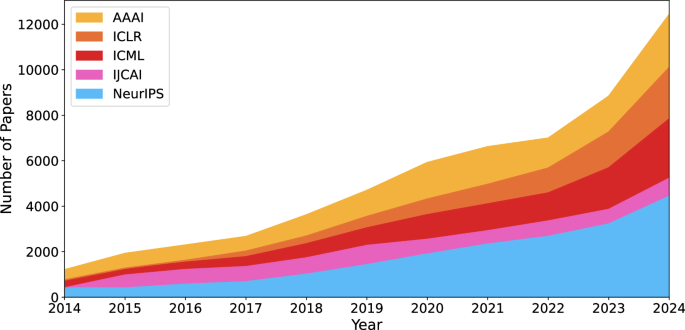
The Decade-Long Push to Make AI Research Actually Work
A ten-year study of 56,800 machine learning papers shows code and data sharing jumped from 11% to 64%, reshaping the foundations of practical AI deployment.