The Decade-Long Push to Make AI Research Actually Work
A ten-year study of 56,800 machine learning papers shows code and data sharing jumped from 11% to 64%, reshaping the foundations of practical AI deployment.
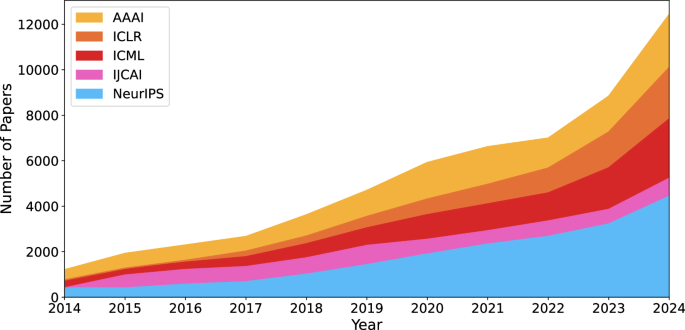
A decade-long analysis of more than 56,000 scientific papers reveals that artificial intelligence research is overcoming its reproducibility crisis, with papers sharing both code and data jumping from 11 percent to 64 percent.
A Decade of Explosive Growth and Shaky Foundations
Over the past ten years, artificial intelligence has expanded from an academic subfield into the primary engine of modern enterprise technology. Yet for much of that period, the scientific rigor underpinning AI was quietly compromised. Researchers routinely published breakthrough results that could not be replicated by external teams, leading observers across computer science to warn that the discipline had inherited the same structural flaws that plagued psychology, medicine, and social science.
Between 2014 and 2024, annual submissions and acceptances across premier computing venues experienced a dramatic ten-fold increase. Five of the most prominent academic conferences, AAAI, ICLR, ICML, IJCAI, and NeurIPS, went from publishing 1,206 papers collectively in 2014 to more than 12,026 in 2024. In the initial years of this boom, the rush to publish novel algorithmic benchmarks consistently outpaced the unglamorous work of documenting experimental environments, tracking random seeds, and publishing raw assets.
This gap created real problems for practitioners outside academic labs. Machine learning papers frequently announced double-digit gains on vision, planning, and language tasks, but when outside engineers attempted to run the code, they were often met with broken dependencies, proprietary or missing training corpuses, and wildly unstable results. The field began to confront what many called a credibility crisis. Without accessible artifacts, published discoveries were little more than unverified claims.
Measuring Transparency Across 56,000 Papers
To determine whether the situation has genuinely improved, researchers conducted an extensive retrospective audit of the published literature over the past decade. The study examined 56,800 scientific articles accepted at the five flagship AI conferences from 2014 through 2024. Rather than relying on anecdotal accounts or small sample surveys, the investigation established seven distinct documentation variables to track how authors recorded their methodologies, open-sourced their codebases, and shared their datasets.
The findings show a marked historical shift in how machine learning is documented. In 2014, only 11 percent of accepted papers provided simultaneous access to both their underlying source code and the evaluation data required to recreate the experiments. Over the subsequent ten years, that proportion rose nearly sixfold. By 2024, approximately 64 percent of papers at these top venues openly supplied both code and data.
Based on empirical reproducibility models developed in earlier benchmark studies, the researchers inferred that the overall likelihood of a study being fully reproducible advanced in tandem. In 2014, an estimated 28 percent of published research met the functional bar for independent replication. By 2024, that figure had climbed to 64 percent. While nearly a third of papers still fall short of complete open-science criteria, the baseline expectation for publishing in AI has fundamentally transformed from opaque claims to public evidence.
Cultural Momentum Outpaces Institutional Mandates
One of the most notable insights from the decade-long dataset is how this transformation occurred. In the late 2010s, academic institutions and conference steering committees attempted to force greater rigor through procedural mandates. Venues like NeurIPS and JAIR introduced formal reproducibility checklists, requiring authors to explicitly answer whether they had disclosed hyperparameter tuning procedures, computational resources, and seed variability.
However, the trajectory of the data demonstrates that documentation practices were already improving substantially before these checklists became compulsory. The upward curve for code and data releases began several years prior to institutional interventions, pointing to a broader grassroots cultural evolution across the research community rather than compliance driven purely by conference rules.
A confluence of factors drove this cultural change. The widespread adoption of collaborative hosting platforms like GitHub, open dataset repositories, and pre-print archives created a competitive dynamic where transparency became a signal of quality. Authors who published verifiable repositories gained greater visibility, higher citation counts, and immediate community trust. As commercial entities increased their funding of foundational models, openness also functioned as a recruitment and reputation mechanism. Scientific peers began informally penalizing submissions that withheld implementation details, establishing a new community norm long before editorial boards codified it.
The Persistent Hurdles of Real-World Nondeterminism
Despite the clear progress in code and data availability, publishing repositories does not automatically guarantee identical execution. Machine learning remains exceptionally vulnerable to subtle computational variables that can derail replication efforts even when full source code is supplied.
Modern neural networks are notoriously sensitive to execution environments. Discrepancies between hardware architectures, differences in CUDA driver versions, non-deterministic operations across parallel graphics processing units, and minor numerical precision shifts can lead to divergent training runs. Deep reinforcement learning and generative modeling are particularly susceptible, where identical code run with two different random seeds can produce radically different outcomes.
Moreover, the scale of contemporary AI systems has introduced a secondary transparency barrier. While sharing a convolutional vision model or standard tabular dataset was feasible in 2016, modern frontier systems require hundreds of gigabytes of proprietary telemetry, cluster-scale compute budgets, and specialized training pipelines that cannot easily be packaged into an open repository. Even when source code is released, running the pipeline often remains prohibitive for independent evaluators who lack enterprise-level infrastructure. As recently reported by Nature, the community has made substantial structural strides toward open science, yet closing the final gap between shared assets and push-button reproducibility remains an active challenge.
Why it matters
For enterprise operators, field technicians, and infrastructure engineers, the reliability of academic AI research is far from an abstract concern. As machine learning migrates out of centralized research laboratories and into industrial field operations, telecommunications switching hubs, and edge hardware, deploying unverified models carries tangible operational risk.
When maintenance engineers and network operators adopt computer vision systems for automated inspections, optical character recognition on remote utility poles, or predictive maintenance inside data center cooling loops, they require algorithms whose failure rates and operational bounds are thoroughly understood. An unvetted model trained on undisclosed data can perform flawlessly in a conference paper yet degrade catastrophically when exposed to the thermal drift, ambient noise, and optical distortions of real-world operational environments.
The industry wide shift toward public code, accessible datasets, and standardized experimental tracking directly improves downstream engineering. It ensures that the computer vision and edge intelligence models embedded in ruggedized field equipment can be properly audited, retrained on local operational data, and debugged without treating the software as a black box. Greater scientific transparency in foundational research creates the predictable, dependable foundation required for mission-critical automation.
More from Trends
RSS
Silicon Valley's Capital Influx Is Reshaping Biomedical Science
A massive influx of software and AI wealth is transforming biomedical research, replacing slow grant cycles with computational models and private moonshots.
Industrial Food Production Tests the Limits of Factory Floor AI
AI is reshaping food manufacturing and safety inspection, but bridging the gap between lab benchmarks and messy factory environments remains an operational hurdle.

Rethinking the Black Box: Inside the Debate Over Neural Network Legibility
A fresh look at neural network inner workings suggests large models may be far easier to decode, monitor, and audit than previously thought.