The Boundaryless Worker: How AI Awareness Is Rewiring Early Career Strategy
New research shows students aware of AI are abandoning traditional career ladders, propelled by equal parts technical curiosity and fear of automated displacement.
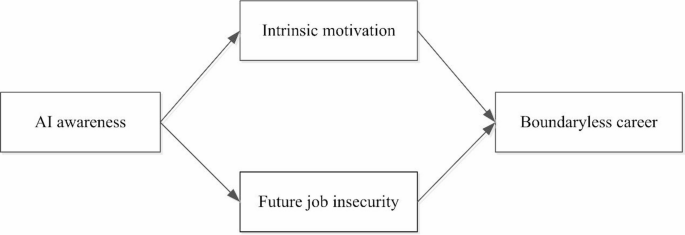
University students aware of artificial intelligence increasingly plan for non-linear, multi-employer careers, driven simultaneously by an urge to master new tools and the fear of automated displacement.
For decades, higher education operated on a predictable compact. Students chose a discipline, acquired a foundational body of knowledge, and stepped onto a relatively well-defined career ladder within a stable industry. Advancement meant climbing within an organization or moving laterally between comparable corporate peers.
Artificial intelligence has dismantled the foundation of that compact. As automated systems move beyond manual automation into analytical, creative, and cognitive tasks, the assumption that a single professional identity will remain viable for decades is evaporating. Rather than viewing their careers as linear trajectories within corporate hierarchies, the emerging workforce is adopting what organizational sociologists describe as a boundaryless career mindset. In this model, individuals structure their working lives across organizational boundaries, dynamic project ecosystems, and evolving skill domains rather than relying on a single employer for long-term security.
Rethinking the Corporate Ladder
The shift toward boundaryless careers is not simply an organic evolution in youth work culture. It represents a direct psychological and structural adaptation to the accelerating presence of artificial intelligence across the global economy. As algorithmic tools absorb entry-level analytical workloads, the traditional training ground for junior professionals is shrinking.
In response, students and early-career workers are altering how they perceive professional longevity. A boundaryless orientation prioritizes transferable competencies over organizational loyalty. It favors workers who cultivate multidisciplinary resource integration, rapid tool adoption, and cross-platform mobility. Under this framework, an individual's career capital is determined not by their tenure at a specific enterprise, but by their capacity to navigate changing technical ecosystems, transition between distinct project roles, and construct flexible professional networks.
This orientation rejects the idea that stability comes from an external employer. Instead, security is internalized. The worker becomes an independent operator managing a portfolio of capabilities, ready to pivot as technical disruptions alter market demand.
Two Opposing Forces Pointing to the Same Exit
What drives a student to abandon the safety of a conventional career track in favor of a fluid, boundaryless path? Recent behavioral investigations highlight an intriguing dynamic: two opposing psychological mechanisms are operating in parallel to produce the exact same outcome.
The first driver is intrinsic motivation. As students observe the expanding capabilities of generative models, intelligent agents, and automated workflows, many feel drawn to the frontier of these technologies. They see AI as an intellectual amplifier that rewards creative problem-solving, autonomous experimentation, and cross-disciplinary synthesis. This cohort does not want to be boxed into rigid corporate roles with narrow job descriptions. Their boundaryless orientation stems from curiosity, ambition, and a desire to engage with novel, self-directed challenges across diverse operational domains.
The second driver is future job insecurity. On the other side of the psychological ledger sits the acute recognition that routine intellectual labor is vulnerable to automation. Students realize that entering a traditional corporate structure offers no guarantee of immunity against restructuring or algorithmic replacement. The perception of vulnerability destabilizes the psychological contract between worker and firm.
Faced with the prospect of precarious employment, students treat organizational independence as a defensive strategy. If relying on a single firm carries existential risk, spreading professional exposure across multiple domains, projects, and specialized skills becomes the rational survival mechanism. Both the optimistic pursuit of mastery and the defensive response to disruption point toward the same structural conclusion: workers must remain mobile, agile, and detached from traditional corporate bonds.
Experimental Proof of the Shift
While workplace analysts have long theorized that technological shifts influence career expectations, rigorous empirical validation has often lagged behind corporate speculation. A comprehensive investigation recently published in the journal Nature evaluated these psychological pathways across three coordinated studies, combining broad survey datasets with controlled experimental methodology.
The researchers set out to measure the precise impact of AI awareness on university students' career attitudes, drawing upon conservation of resources theory and self-determination theory. In the observational stages of the research, students who exhibited higher awareness of AI trends demonstrated a pronounced inclination toward boundaryless career orientations. Statistical modeling confirmed that this relationship was mediated in parallel by both elevated intrinsic motivation and heightened perceptions of future job insecurity.
Crucially, the researchers conducted an experimental phase to establish direct causality rather than mere correlation. Participants were exposed to interventions designed to heighten their awareness of artificial intelligence capabilities and their real-world labor market penetration. The experimental results confirmed the causal chain: directly increasing an individual's awareness of AI led to simultaneous increases in both intrinsic motivation and anxiety regarding future job stability.
By demonstrating that heightened awareness triggers both psychological responses at once, the study dispels simplistic narratives that characterize young professionals as either purely terrified of automation or entirely enthusiastic about technological novelty. In reality, early-career workers operate under both pressures simultaneously. They are energised by the productive potential of the technology while remaining clear-eyed about the threat it poses to traditional career safety nets.
From Stable Employment to Continuous Adaptation
The consequences of this mindset shift will reshape recruitment, workforce management, and enterprise structure over the coming decade. Organizations that rely on traditional retention strategies, such as offering gradual tenure-based promotions or static benefits packages, will struggle to engage workers who prioritize modular capability over institutional longevity.
Instead of seeking lifetime employers, incoming talent actively evaluates organizations on their utility as skill incubators. If a role does not offer exposure to cutting-edge technical workflows, dynamic cross-functional initiatives, or opportunities to build autonomous problem-solving capabilities, boundaryless professionals will quickly move elsewhere. The emergence of hybrid titles, such as prompt designers, workflow automation specialists, and applied AI integrators, highlights how quickly standard job descriptions are decomposing into fluid project assignments.
This environment compels universities and enterprise training pipelines to rethink professional development. Preparing young workers for the modern economy cannot focus merely on static subject-matter mastery. Technical curricula must emphasize meta-learning, psychological resilience, and adaptive resource management. When the tools governing an industry are updated on quarterly cycles, the defining skill of a sustainable career is not knowing an answer, but knowing how to reconstruct one's operational toolkit on demand.
Why It Matters
This shift toward boundaryless, self-directed careers has direct operational implications for industries anchored in mission-critical physical infrastructure, including telecommunications, data centre operations, and industrial field services.
Historically, telco operators and data centre facilities depended on stable, long-tenured field technicians and systems engineers who developed deep institutional knowledge over decades within the same corporate hierarchy. However, as automation, intelligent monitoring agents, and augmented reality diagnostic platforms penetrate field engineering, incoming technical talent is adopting the same boundaryless mindset seen in corporate knowledge sectors.
Younger technicians and infrastructure specialists increasingly view their positions as modular, technical deployments rather than permanent organizational homes. They expect to interact directly with AI-driven diagnostics, automated telemetry, and AR-assisted work instructions, treating these tools as personal skill multipliers rather than company-specific workflows.
For operators managing hyperscale data centres or nationwide fiber rollouts, retaining elite field and infrastructure talent will require abandoning legacy hierarchy models. Facility managers and engineering directors must provide high-agency, technology-rich environments that satisfy technicians' intrinsic drive to master advanced systems, while mitigating the systemic friction caused by rapid workforce turnover.
More from Trends
RSS
The Exoskeleton Dilemma: Why Generative AI Boosts Performance Without Building Skill
A randomized trial reveals that while AI helps non-specialists complete technical work, the capability vanishes the moment the tool is removed.

Anthropic Files for IPO, Revealing Rocketing Enterprise Revenue and $600 Billion in Compute Commitments
Anthropic's IPO filing shows revenue topping $16 billion in early 2026, paired with unprecedented long-term compute contracts and tightly held founder governance.
Closing the AI Value Gap: Why Enterprise Transformation Demands Physical and Operational Overhauls
Moving enterprise AI from experimental pilots to measurable balance-sheet returns requires rewiring core workflows, data architectures, and industrial operations.