The Exoskeleton Dilemma: Why Generative AI Boosts Performance Without Building Skill
A randomized trial reveals that while AI helps non-specialists complete technical work, the capability vanishes the moment the tool is removed.
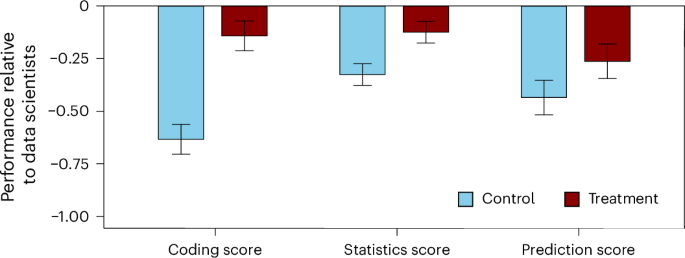
Generative artificial intelligence allows non-specialist workers to complete complex technical tasks, but a randomized trial shows those performance gains disappear the moment the software is removed.
For enterprise leaders, the promise of generative artificial intelligence has often been framed as rapid workforce upskilling. Rather than spending years in graduate programs or technical apprenticeships, professionals can supposedly tap conversational models to bridge complex capabilities, turning generalist consultants or frontline operators into functional programmers, data analysts, and technical problem solvers.
Yet new experimental evidence suggests that this framing misinterprets how AI changes human ability. Generative models do not accelerate learning in the traditional sense. Instead, they act as an intellectual exoskeleton. They dramatically amplify what a worker can deliver while wearing the suit, but they leave the underlying human capability largely untouched once the power is switched off.
Testing the Boundaries of AI-Driven Upskilling
To determine whether AI truly teaches workers or merely does the heavy lifting for them, researchers conducted a randomized controlled trial involving 487 management consultants. The participants were tasked with solving complex data science challenges that sat well outside their core domain expertise. Importantly, the researchers engineered the tasks so that an AI model could not solve them entirely on its own. Success required human intervention, critical oversight, and the ability to guide the tool through iterative troubleshooting.
One group of consultants was given access to OpenAI's ChatGPT alongside structured training on how to prompt and collaborate with the model to address data science workflows. The control group attempted the same tasks without generative assistance.
Across three distinct technical challenges, the AI-equipped consultants significantly outpaced their unassisted peers. They wrote functional code, shaped messy datasets, and derived analytical insights that would normally have required specialized technical training. The technology visibly compressed the gap between non-technical staff and domain specialists, enabling generalists to navigate technical terrain that would have previously stopped them in their tracks.
However, the boundaries of this performance boost were clear. While the augmented consultants outperformed the control group, they still fell far short of expert data scientists evaluated under the same conditions. The AI provided leverage, but it did not bestow genuine domain mastery.
The Disappearing Capability
Crucially, the experiment did not stop at task completion. The researchers tested the participants afterward to measure how much technical knowledge they had actually retained. Without ChatGPT available, the participants were asked to answer conceptual and practical questions about the data science work they had just completed.
In this follow-up assessment, the workers who had spent hours successfully deploying ChatGPT scored no better than those who had never used it. Their demonstrated ability to produce complex code and perform analytics left no measurable trace in their underlying technical comprehension.
This finding challenges the conventional definition of corporate upskilling. Historically, upskilling represents an enduring internal upgrade. A worker acquires concepts, forms mental models, commits rules to memory, and learns how to navigate edge cases through practice. Generative AI, by contrast, provides immediate execution without requiring the cognitive friction that makes knowledge stick. When a conversational agent writes the script, identifies the syntax error, and interprets the library dependencies, the human operator bypasses the effortful problem-solving that cognitive science identifies as essential for retention.
The Mechanics of Cognitive Offloading
Educational psychologists have long documented the principle of desirable difficulty. Deep learning requires a degree of struggle. When an engineer debugs a failing routine or an analyst tracks down an error in logic, the cognitive friction forces the brain to organize and consolidate information.
Generative AI removes this friction entirely. The consultant interacting with ChatGPT is engaged in coordination rather than internal synthesis. They state an intent, inspect the output at a high level, and ask for corrections. The model acts as the cognitive engine, while the human acts merely as a supervisor.
This arrangement is remarkably effective for immediate throughput, but it creates a fragile operational dynamic. If an organization measures worker development purely by deliverables, it risks mistaking tool-dependent output for human capital. As detailed in a randomized controlled trial published in Nature, treating AI as a teaching tool when it functions primarily as an operational prosthesis creates a false sense of institutional competence.
Workers who rely entirely on such assistance often develop an inaccurate perception of their own mastery. Because the software executes tasks with smooth, fluent prose, users easily succumb to an illusion of competence, believing they understand the underlying mechanics simply because they were able to prompt the model into producing the right outcome.
The Enterprise Trap of Synthetic Capability
For enterprise leadership, these findings carry significant strategic weight. If an organization assumes that rolling out AI assistants to its workforce is equivalent to an upskilling program, it risks creating fragile operational dependencies.
First, there is the issue of technological lock-in and business continuity. When an enterprise scales technical operations relying on workers who only function with an active AI interface, the human baseline remains static. If system access fails, if API costs fluctuate, or if latency degrades, the workforce immediately reverts to its original, non-technical state. The organization has not built internal talent; it has merely leased external execution.
Second, quality assurance becomes a structural liability. In the trial, augmented consultants still could not match true domain experts. When non-specialists rely on generative tools to navigate fields they do not fundamentally understand, they lack the mental models needed to identify subtle hallucinations, security vulnerabilities, or algorithmic bias. They can produce plausible work, but they cannot evaluate it with the rigor of someone who understands first principles.
Organizations must therefore delineate between two distinct workforce strategies. The first is operational leverage, where AI is acknowledged as a permanent execution layer that workers must continually wield. The second is genuine professional education, which still requires traditional, friction-heavy pedagogy that forces workers to understand underlying concepts without a machine providing the answers.
Why it matters
This distinction is particularly critical outside office environments, where generative intelligence is being deployed into field service, telecom, and critical physical infrastructure.
In data centre operations and telecommunications networks, companies are outfitting technicians with augmented reality headsets and conversational AI assistants to handle unfamiliar hardware, diagnose optical backhaul failures, or configure complex routing protocols. While these systems allow junior field staff to perform sophisticated maintenance that once required veteran engineers, operators cannot afford to confuse assisted execution with acquired tradecraft.
If a field technician in a hyperscale facility relies entirely on an AI overlay to identify breaker loads or diagnose fiber splicing errors, they can successfully finish the job today. But without true comprehension, their ability to spot non-standard anomalies, manage edge cases, or maintain safety protocols during an unscheduled network blackout remains unevolved. Operational leaders must recognize that generative tools provide tremendous leverage on the site floor, but they do not replace the hard, deliberate work of training skilled technicians who understand how the systems actually function.
More from Trends
RSS
Anthropic Files for IPO, Revealing Rocketing Enterprise Revenue and $600 Billion in Compute Commitments
Anthropic's IPO filing shows revenue topping $16 billion in early 2026, paired with unprecedented long-term compute contracts and tightly held founder governance.
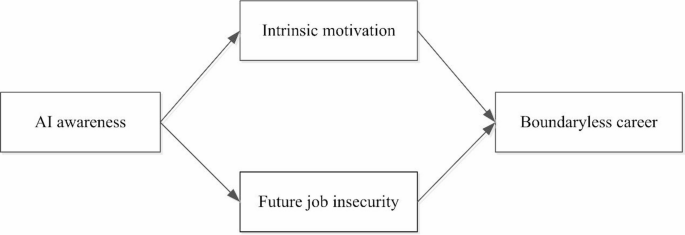
The Boundaryless Worker: How AI Awareness Is Rewiring Early Career Strategy
New research shows students aware of AI are abandoning traditional career ladders, propelled by equal parts technical curiosity and fear of automated displacement.
Closing the AI Value Gap: Why Enterprise Transformation Demands Physical and Operational Overhauls
Moving enterprise AI from experimental pilots to measurable balance-sheet returns requires rewiring core workflows, data architectures, and industrial operations.