The Structural Shift: Why Autonomous Agents Demand a Full Redesign of Cloud Infrastructure
Autonomous AI agents break the classic request-response cloud model, forcing a fundamental co-design of silicon, stateful storage, and ultra-low-latency networks.

TL;DR: The rise of autonomous AI agents executing multi-day, unpredictable workflows is forcing enterprise cloud architecture to shift from modular scaling to tightly integrated systems.
The Departure from Request-Response Computing
For nearly two decades, modern cloud architecture evolved around a predictable rhythm. Web applications, microservices, and standard enterprise databases relied on synchronous or asynchronous request-and-response paths. A client initiated a call, a container spun up or accepted the task, compute processed the payload, and data was written or retrieved before closing the session. Even the initial wave of generative artificial intelligence followed this template. A user typed a prompt into an interface, a hosted foundation model generated a sequence of tokens in return, and the transaction concluded.
Agentic AI breaks this architectural paradigm. Autonomous agents do not behave like transactional microservices. Rather than handling isolated queries, an enterprise agent takes an objective, formulates a multi-step plan, calls external software tools, compiles code, scans external repositories, and verifies its own outputs.
This workflow is non-linear and temporally extended. An agent may execute autonomously for twenty minutes, three hours, or several days. During that operational lifecycle, resource requirements swing wildly. An agent might idle while waiting for an external database query or an approval flag, demand a sudden surge of compute to run inference across a large reasoning model, write intermediate results to persistent storage, and then invoke a secondary tool that routes traffic across multiple third-party systems. Conventional cloud abstractions, built around stateless containers and steady-state autoscaling, were not engineered to manage these volatile, state-dependent workloads efficiently.
The Co-Design Imperative Across Silicon, Memory, and Fabric
Supporting this new class of software requires moving away from the traditional model of infrastructure upgrades, where compute, storage, and networking are treated as distinct commodities upgraded on independent cadences. In an agentic environment, simply provisioning faster accelerators or denser server racks yields diminishing returns if the rest of the operational stack cannot keep pace.
State preservation represents one of the most critical engineering hurdles. Because an agent must maintain context, execution history, and memory across long spans of time, the underlying platform cannot afford to discard runtime state between reasoning steps. If an agent pauses while awaiting the result of a sub-task, its working memory must be preserved without consuming expensive accelerator memory indefinitely. Transferring that context between high-bandwidth memory, host system memory, and non-volatile storage tiers requires high-throughput data paths designed specifically for state swapping.
Networking infrastructure faces an equivalent strain. As complex tasks get divided among networks of specialized agents, cross-system communication spikes. Large parameter models must communicate with smaller, task-specific models, retrieval engines, and internal enterprise systems. If interconnects suffer from jitter, dropped packets, or high tail latency, the entire reasoning chain slows down. Silicon, compute nodes, stateful storage fabrics, and high-speed networking must be co-designed as a single, coherent machine rather than an assortment of loosely coupled components.
Fleet Management and the Multi-Agent Paradigm
As organizations shift from running exploratory pilots to deploying autonomous agents at scale, operational complexity compounds quickly. Different tasks require fundamentally different computational profiles. A customer-facing routing agent prioritizes low latency and minimal time-to-first-token. A financial auditing agent or an automated code refactoring pipeline demands extended reasoning, deep context windows, and high algorithmic precision, where latency is secondary to deterministic accuracy.
Managing this heterogeneity requires a unified operational plane. Enterprises cannot sustainably build distinct operating environments for every combination of foundation model, specialized runtime, and hardware accelerator. Infrastructure teams require end-to-end visibility across their entire compute footprint to track token economics, pinpoint execution bottlenecks, and balance performance against operational cost.
Consider the operational pivot at Levi Strauss & Co., which overhauled its digital footprint by migrating legacy data centres, consolidating enterprise resource planning platforms, and creating a unified real-time data layer. The retailer is now deploying an orchestrator architecture, effectively a central coordinator managing more than 1,000 domain-specific agents across different business operations. Running an ecosystem of that scale demonstrates that agentic workloads cannot sit atop fragmented infrastructure. Without a shared foundation governing data access, security protocols, and resource allocation, multi-agent deployments collapse under their own management overhead.
Using Agents to Operate the Underlying Platform
As the demands on digital infrastructure outstrip traditional configuration methods, the operations layer itself is increasingly being turned over to machine intelligence. Human site reliability engineers and systems administrators face systems that change state too rapidly for manual diagnostics, threshold-based monitoring, and scripted runbooks.
The next evolution of cloud engineering involves closing the loop, using purpose-built agents to monitor, triage, and optimize the hardware and software layers that support other AI workloads. In this model, operational agents continuously inspect telemetry across network fabrics, memory channels, and server thermals.
When a bottleneck forms, whether caused by an unpredicted memory leak in an agentic loop, a noisy neighbour saturating top-of-rack switches, or degraded performance on a specific accelerator, operational agents can reroute traffic, reallocate compute capacity, or checkpoint and migrate long-running jobs before an outage cascades across the fleet. Infrastructure is shifting from a static hosting environment into an adaptive system that actively tunes itself around the work running across its nodes.
Evaluating Enterprise Readiness for the Agentic Shift
Organizations evaluating whether their current architecture can support autonomous workloads must address several practical questions:
1. Can the existing stack deliver the required network bandwidth, state preservation speeds, and dynamic scaling, or is the enterprise attempting to run persistent, stateful reasoning loops on infrastructure built for stateless web apps? 2. Does the platform provide the flexibility to run varied model architectures, specialized runtimes, and targeted silicon without multiplying operational complexity and administrative siloes? 3. Is the enterprise leveraging autonomous intelligence inside its own operations to automate deployments, preempt operational incidents, and control infrastructure costs in real time?
As detailed in a recent industry perspective published by Wired in collaboration with Microsoft Azure, building for the next phase of enterprise automation requires viewing the cloud platform as an integrated system engineered for sustained execution rather than brief transactional spikes.
Why It Matters
For field engineers, data centre managers, and telecommunications operators, the shift to agentic AI changes the physical reality of compute. Data centres can no longer be planned purely around uniform power draws and static thermal profiles. Workloads that cycle between heavy reasoning bursts and state-swapping phases create dynamic power swings and concentrated thermal loads that test rack-level power distribution and liquid-cooling installations.
In telecommunications and edge environments, the demands are equally pronounced. As autonomous agents move closer to physical operations, such as managing remote cellular towers, monitoring power substations, or guiding robotic maintenance, edge nodes must support local inference with persistent local state. Technicians and operators will need to maintain interconnected, intelligent edge platforms where hardware failure directly halts autonomous decision-making. The resilience of the physical plant and the stability of the underlying fabric are becoming indistinguishable from the software running on top.
More from Trends
RSS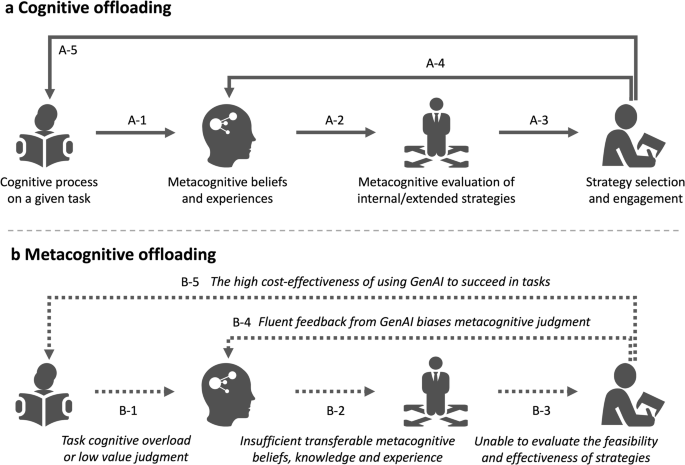
The Metacognitive Cost of AI Assistance
New research shows how generative AI can boost short-term output while degrading deep learning, presenting a framework to keep human skill sharp alongside automated systems.
The Agentic Shift: How Autonomous Software Is Taking Over Enterprise Workflows
Enterprise IT is moving beyond generative chatbots toward autonomous agents that reason, plan, and execute actions, fundamentally reshaping corporate software stacks.

How Agentic AI Is Reshaping the Modern Executive Suite
CEOs are turning to autonomous AI agents to manage corporate knowledge, cut meetings, and critique strategy, fundamentally altering executive workflow.